


How to Bridge from Base to Solana Quickly and Securely


Table of Contents
- Key Takeaways
- Why Bridge Base to Solana?
- Common Issues with Base to Solana Bridges
- Step-by-Step Guide: How to Bridge Base to Solana Using deBridge
- What Makes deBridge Unique for Base to Solana Flows
- For Developers: Add Base to Solana Bridging to Your App
- deBridge Security Summary
- Conclusion
- Frequently Asked Questions (FAQs)
- Related Resources
Bridging from Base to Solana is one of the most traveled routes in DeFi right now, and for good reason. Base has become the home of stablecoin liquidity, Aerodrome yields, and Coinbase-driven onramps. Solana owns the action: memecoins, perps, NFT mints, and the fastest consumer crypto apps. Users move USDC and ETH from Base into Solana to trade, then back again, sometimes multiple times a week. The route is busy, but the tools to use it are not great.
Most bridges that connect Base to Solana still rely on wrapped tokens, pooled liquidity, or a multi-hop path through Ethereum. Each adds risk, slippage, or 10-plus minutes of waiting. There is no official Base to Solana bridge either; the canonical Base bridge only handles Ethereum mainnet. deBridge fixes this with native asset delivery, 0-TVL architecture, and settlement in 1-2 seconds, making it the fastest and safest way to bridge from Base to Solana.
Key Takeaways
- Bridging from Base to Solana unlocks access to Solana DeFi, memecoin markets, perps platforms, and NFT mints using capital held on Base.
- Most Base to Solana bridges depend on wrapped tokens, liquidity pools, or Ethereum hops, introducing settlement delays, slippage, and security risk.
- deBridge uses 0-TVL architecture and native asset transfers, so funds arrive on Solana as real SOL or real USDC, never wrapped IOUs.
- Real-time settlement in 1-2 seconds makes deBridge the fastest and safest Base to Solana bridge available today.
Why Bridge Base to Solana?
Base and Solana sit at opposite ends of the same problem. Base is one of the fastest-growing L2 right now. Native USDC issued by Circle, the deepest stablecoin pools on any L2, Coinbase distribution, and predictable yield through Aerodrome and Aave all live there. It is where capital sits.
Solana is where capital moves. High throughput, sub-second finality, super-low fees, and a trading culture that rewards speed have made it the venue for memecoin discovery, perp trading, and consumer-facing crypto apps. Holders bridge from Base to Solana to access that liquidity and that pace, and back again when it is time to rebalance.
Common Use Cases
- Memecoin Trading: Access Pump.fun, BONK, WIF, and the rest of Solana's onchain trading culture using USDC or ETH from Base.
- Perps and Active Trading: Solana DEX perps platforms like Phoenix and Jupiter Perps benefit from sub-second finality, making them better suited to high-frequency strategies than slower chains.
- NFT Mints: Participate in Solana NFT launches on Magic Eden or Tensor without holding SOL in advance.
- Yield and Liquid Staking: Deploy into Kamino, Jito, or Marinade for Solana-native yield once your stable position is on the right chain.
Whether you are chasing alpha on Solana, rotating into stablecoins on Base, or running cross-ecosystem strategies, the Base to Solana bridge is the connective tissue that makes it possible.
Common Issues with Base to Solana Bridges
Most Base-to-Solana bridges still rely on legacy mechanisms. The lack of an official bridge makes this worse, as users default to whichever third-party tool ranks first, regardless of how it actually works under the hood.
Common Bridging Pain Points
- Wrapped Tokens on the Destination: Many bridges deliver wrapped USDC or synthetic SOL on Solana instead of the real asset.
- Multi-Hop Routing Through Ethereum: Some bridges route Base to Solana through the Ethereum mainnet. That means two bridge transactions, two sets of gas fees, and 10 to 20 minutes of waiting on L1 finality.
- Liquidity Pool Risk: Pool-based bridges hold user funds in smart contracts on both chains, making them targets for exploits.
- Slippage on Larger Transfers: AMM-style bridges incur slippage on transfers above a few thousand dollars, especially on illiquid Base-to-Solana pairs. The quote you see is rarely the rate you get.
How deBridge Solves It
- Native asset bridging: You receive native SOL, USDC, or any other asset, ready to use anywhere.
- 0-TVL architecture: No liquidity pools, no honeypot for attackers to drain.
- Direct Base-to-Solana routing: No need for an Ethereum hop, saving both cost and settlement time.
- Multi-wallet support: Choose your preferred wallet on any chain.
Step-by-Step Guide: How to Bridge Base to Solana Using deBridge
deBridge provides an instant bridging solution to help you bridge assets between Base and any asset on the Solana network. Let's explore how to bridge your crypto assets in a few simple steps.
- Visit app.debridge.com.
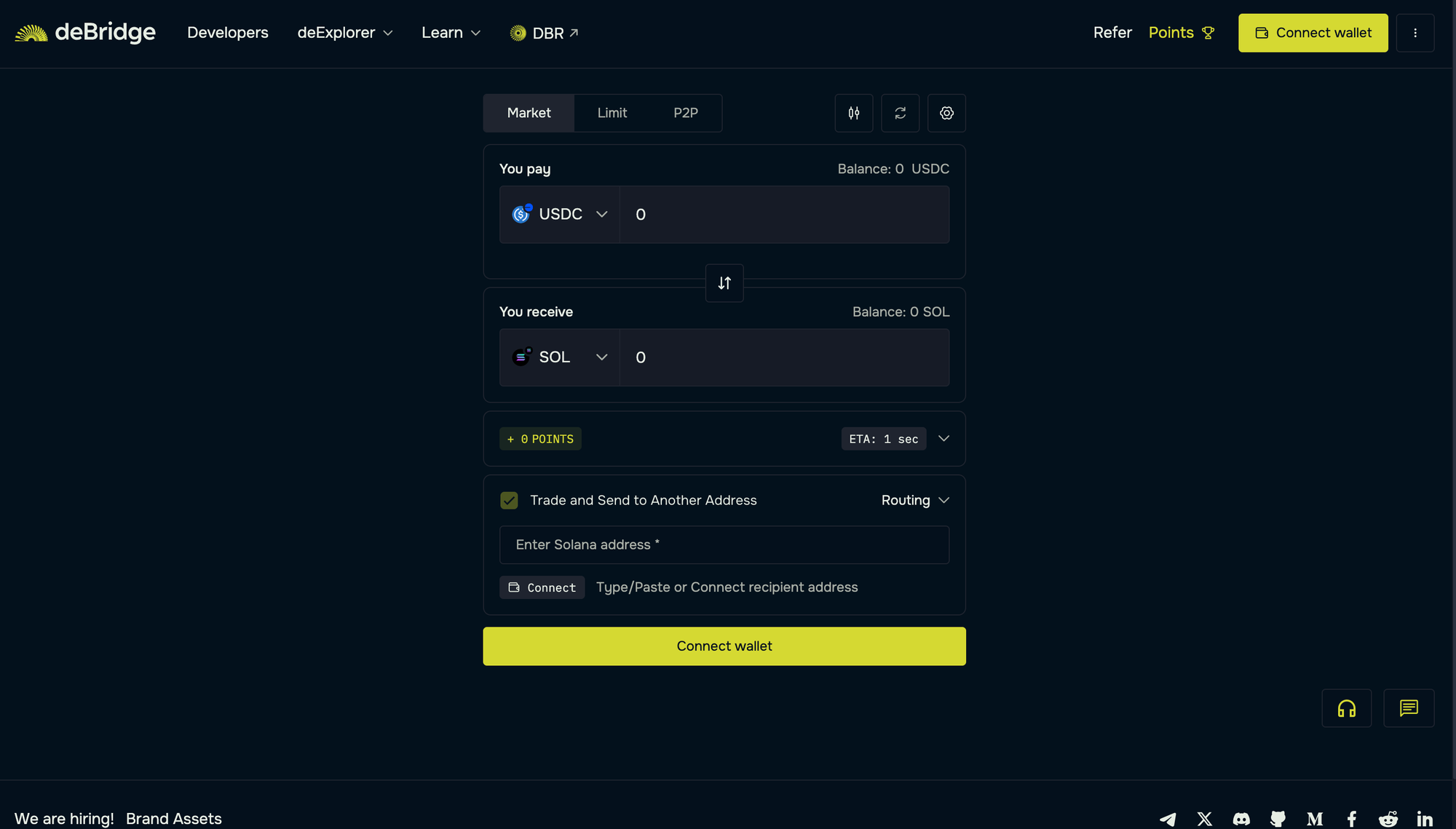
- Connect your Base wallet (MetaMask, Rabby, Coinbase Wallet) as the source. Then connect your Solana wallet (Phantom, Solflare) as the destination.
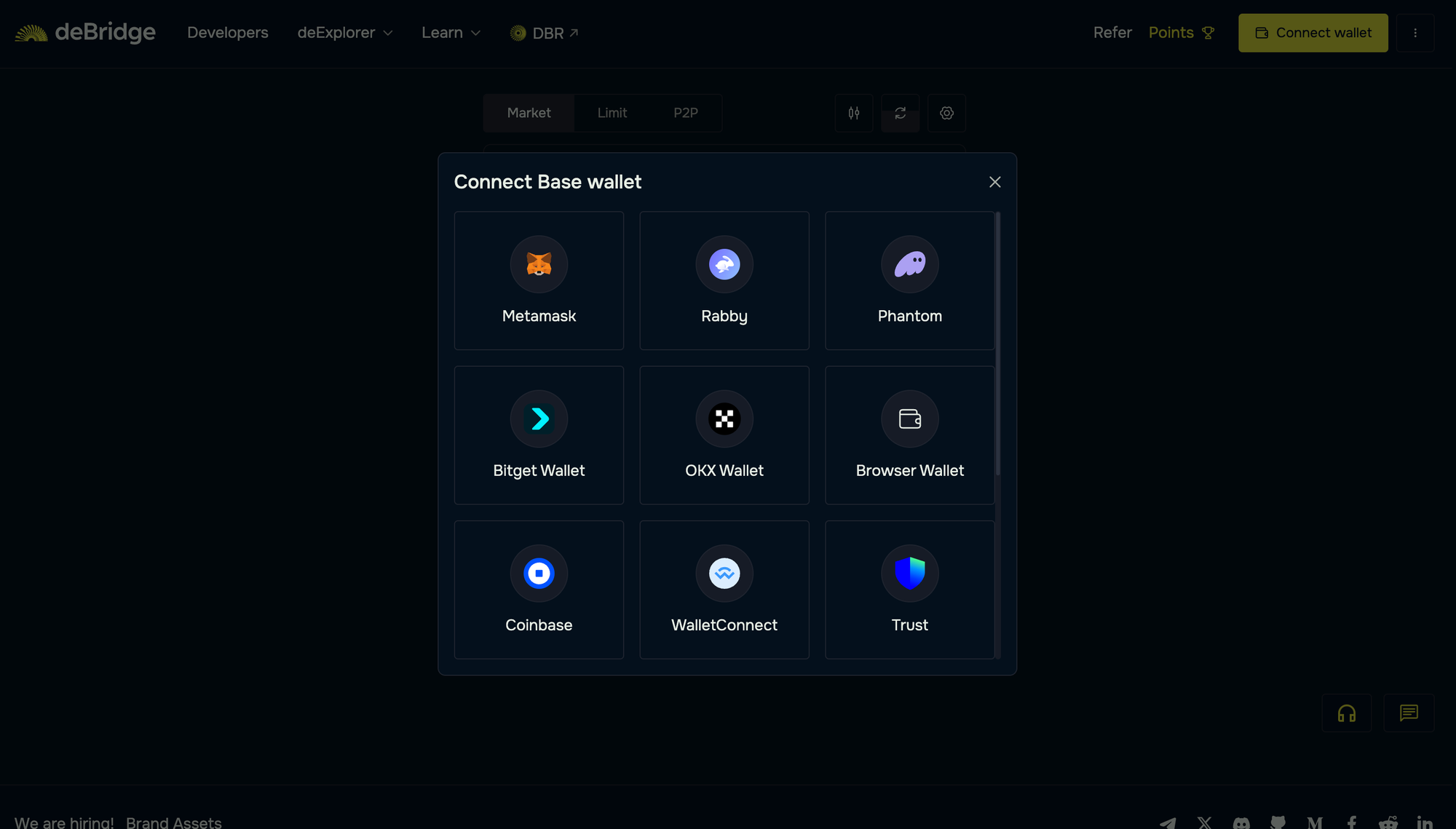
- Select Base as the source chain and the asset you want to bridge. The most common choices are USDC or ETH.
- Select Solana as the destination chain and the token you want to receive. SOL, native USDC on Solana, or any major Solana-based token.
- Enter the quantity and review the transaction details.
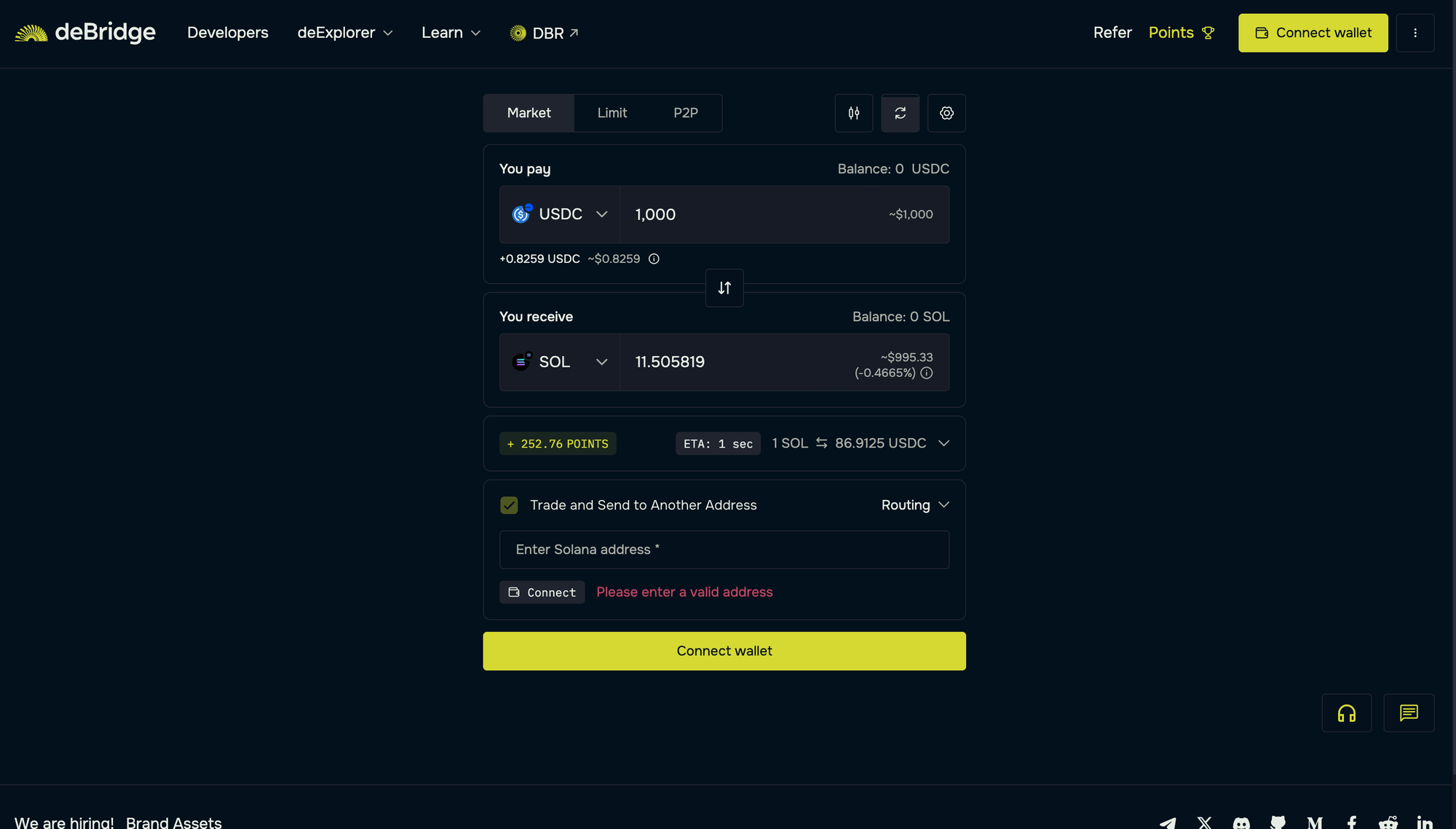
- Confirm the trade, pay gas in ETH on Base, and sign the transaction.
The bridging process takes 1-2 seconds, and you'll see the "Order Fulfilled" pop-up, which indicates that the bridged assets (SOL) have been received in your Solana wallet.
Pro Tips
- Make sure your Solana wallet holds a small amount of SOL for rent and future transaction fees. Even 0.01 SOL is enough to cover everything you will need for the first few interactions.
- Verify the destination token contract before signing for your safety.
Technical users can inspect any deBridge transaction on the deBridge explorer.
What Makes deBridge Unique for Base to Solana Flows

deBridge stands out from traditional bridges with a 0-TVL architecture that eliminates the risk of pooled liquidity. It provides native asset delivery, with no wrapped versions on the destination side, and settles in 1-2 seconds rather than the minutes or hours legacy bridges take.
Built for users and developers alike, deBridge supports every major wallet on Base and Solana and offers an SDK, API, and an embeddable widget for teams integrating cross-chain bridging into their apps.
Comparison Table
For Developers: Add Base to Solana Bridging to Your App
deBridge enables native asset delivery in real-time and message flow across 20+ chains. For builders, that means you can drop Base to Solana bridging into your dApp, wallet, or DEX without building cross-chain infrastructure from scratch.
The deBridge API and widget let your users move assets across Base, Solana, Ethereum, Arbitrum, BNB Chain, and 20+ other networks in seconds, with the same native asset guarantees users get directly on app.debridge.com.
Why Integrate deBridge
- Multi-Chain SDK: EVM and Solana support out of the box, including Base.
- Plug-and-Play APIs: Ship cross-chain features in days, not months.
- Real-Time Execution: Assets arrive on the destination chain in seconds, not minutes.
- Affiliate Routing: Earn revenue on every transaction routed through your integration.
deBridge Security Summary
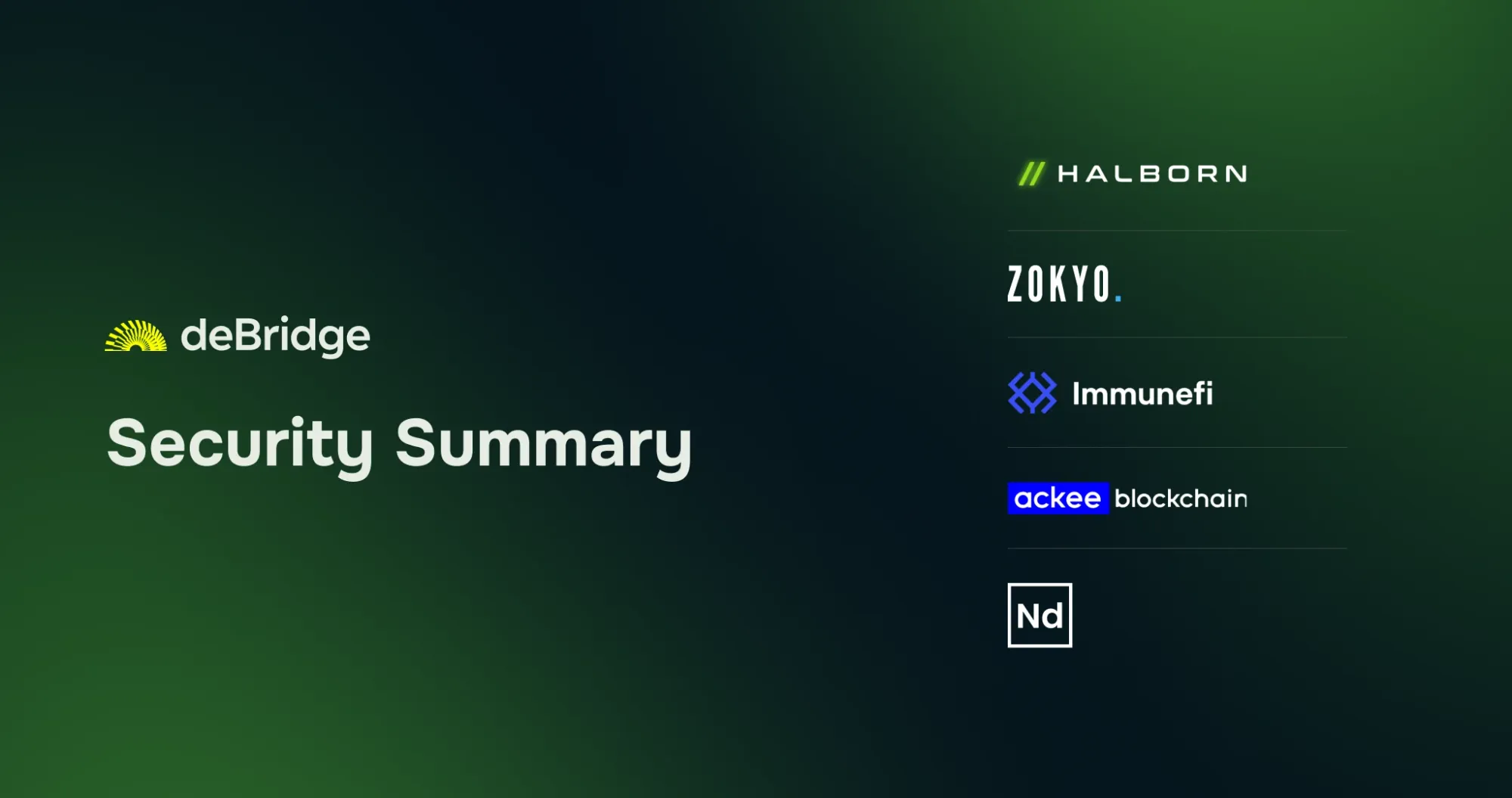
Security is a top priority for bridging, and deBridge is designed keeping that in mind.
Unlike traditional bridges that lock user funds in pooled smart contracts, deBridge uses a 0-TVL architecture, bypassing liquidity pools. This ensures the attack surface is minimized for attack vectors.
With $21B+ in volume settled across 26+ chains, more than 30 security audits, and zero security incidents, deBridge is trusted by ecosystem leaders including Phantom, Jupiter, MetaMask, Solflare, and Trust Wallet.
Why Users Trust deBridge
- 0-TVL = no pooled liquidity risk
- Audited 30+ times, zero security incidents
- Funds delivered before finalization
- Trusted by MetaMask, Phantom, Jupiter, and Trust Wallet
Conclusion
Bridging from Base to Solana opens up the fastest trading ecosystem in crypto using capital that lives on the dollar layer of DeFi. But the traditional path is full of trade-offs: wrapped tokens, pooled liquidity, slow settlement, and gas-doubling Ethereum hops.
deBridge eliminates each of those trade-offs. Native asset delivery, 0-TVL architecture, direct routing, and 1-2 second settlement make it the fastest and safest Base to Solana bridge available today, whether you are moving $100 to chase a Solana memecoin or $100,000 to rebalance across ecosystems.