


Best Base Bridges in 2026


Table of Contents
- What Happened to the Official Base Bridge?
- Key Features to Evaluate in a Base Bridge
- Base Bridge Comparison Table
- 7 Best Base Bridges Reviewed
- Choose the Best Base Bridge Alternative for You
- How to Bridge Funds from Solana to Base with deBridge
- Frequently Asked Questions (FAQs)
Base is building an open network for the global economy and has quickly grown into one of the most active L2s in the ecosystem. The vision for Base is clear; it is built to empower builders, creators, and people everywhere to build apps, grow businesses, create what they love, and earn onchain.
While the demand for Base chain is going parabolic, it is relatively difficult to move assets onto it (or off it) to explore the ecosystem. The official Base Bridge was phased out in late 2025, so there is no longer a single default choice. Instead, Base now points users to third-party bridges and Superchain Bridge providers, making it more important than ever to understand what each one offers.
If you need to connect Base with non-EVM chains such as Solana and Tron, your options become even more limited. This guide compares the seven best Base bridges available in 2026, covering execution speed, security tradeoffs, fee structures, and chain coverage so you can move assets to and from Base with confidence.
Our Picks for the Best Base Bridges in 2026
- deBridge
- Wormhole
- Across
- Stargate
- Orbiter Finance
- Relay
- Squid
What Happened to the Official Base Bridge?
The original bridge was deprecated in late 2025. The Base team decided to shut it down as part of its broader commitment to decentralization and the Superchain vision. Now, they have shifted away from a Coinbase-operated bridge toward a network of independent third-party providers.
Base now directs users to Superchain Bridge providers like Superbridge and Brid.gg for canonical L1-to-L2 transfers, alongside third-party protocols like deBridge, Across, and Stargate for faster execution, broader chain support, and better pricing.
For most users, the deprecation is actually a net positive. The third-party options available today are faster, support more assets, and cover more chains than the official bridge ever did.
Key Features to Evaluate in a Base Bridge
Base sits on the OP Stack, meaning any bridge that supports Optimism rollups can connect to it. That said, there are still points to consider before choosing your base bridge.
Withdrawal Speed: The native Base Bridge uses the standard optimistic rollup withdrawal process, which means a 7-day challenge period for L2-to-L1 transfers. Third-party bridges bypass this entirely, settling in seconds or minutes.
Asset and Chain Coverage: Most Base bridges only connect EVM chains. If you need Base-to-Solana or Base-to-Tron routes, your options are limited to a handful of protocols.
Execution Model: Liquidity pools expose you to slippage on big orders (6 or 7 figures). Intent-based bridges match your trade with a solver or market maker who delivers at a guaranteed rate, removing slippage risk entirely.
Security Architecture: Bridges carry different trust assumptions. Some rely on multisigs, others on optimistic verification, and a few avoid holding any locked liquidity at all. Fewer trust assumptions generally means a smaller attack surface.
Considering these points, let’s review the bridges to help speed up your Base journey.
Base Bridge Comparison Table
7 Best Base Bridges Reviewed
deBridge
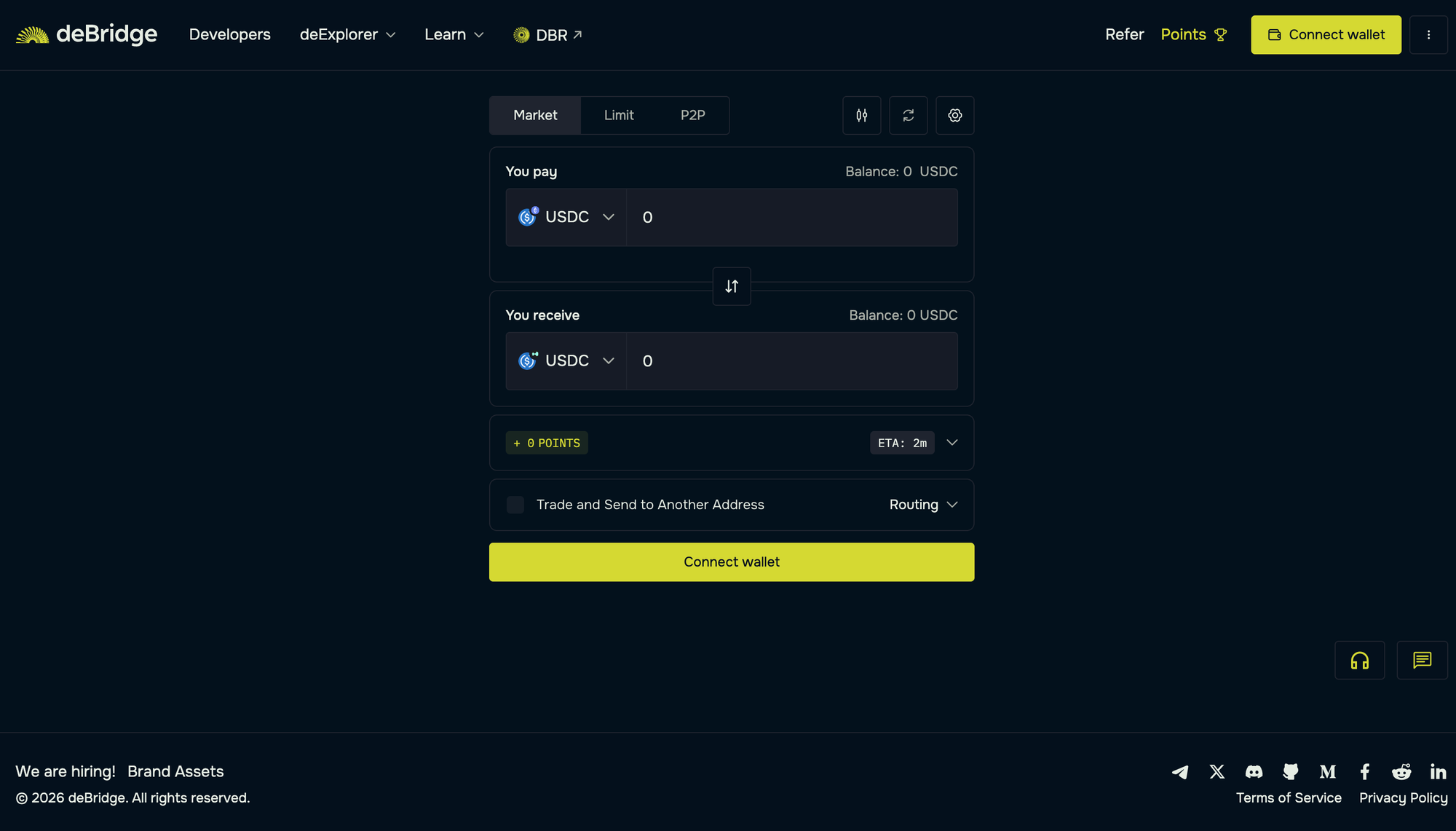
deBridge is a cross-chain execution protocol built on a 0-TVL, intent-based architecture. Instead of using liquidity pools, professional market makers compete through the deBridge Liquidity Network (DLN) to fill your order at a guaranteed rate. You always receive native tokens on the destination chain, not wrapped versions.
For Base users, deBridge offers fast settlement (roughly 2 to 4 seconds) across all major EVM chains. It also supports moving funds to and from Solana and Tron natively, which most Base bridges don't offer.
Top Features
- Zero-TVL model eliminates pool-based exploit risk.
- Guaranteed rate at quote time, no slippage regardless of order size.
- Native Solana & Tron support alongside full EVM chain coverage.
- Competing market makers create tighter spreads through DLN.
- Native token delivery on every destination chain.
Pricing
deBridge charges a flat fee and a variable fee of 4 bps, paid in the input token. The full cost is displayed before you confirm your transaction.
Wormhole
Wormhole is a widely connected cross-chain protocol that supports over 30 blockchain networks. It functions as both a token bridge and a general messaging layer. For Base users who need to reach Solana or a broad range of ecosystems, Wormhole covers more routes than most alternatives except for Tron.
Top Features
- Over 30 supported chains spanning EVM and non-EVM ecosystems.
- General messaging protocol enabling more than simple token transfers.
- NTT framework for native cross-chain token deployments.
Pricing
Low protocol-level fees per transfer. Destination-chain gas is usually the primary cost.
Across
Across uses an intent-based model with optimistic verification powered by UMA's oracle. Relayers front capital on the destination chain and get reimbursed after a short verification window, resulting in fast EVM-to-EVM settlement.
Top Features
- Sub-10-second settlement on most Base routes.
- Intent-based relayer competition for order fulfillment.
- L2 coverage includes Arbitrum, Optimism, Base, Polygon, and more.
Pricing
Relayer fee plus a small LP spread. Competitive on standard-size transfers between Base and other EVM chains.
Stargate
Stargate is a composable liquidity transport protocol built on top of LayerZero. It pools liquidity across chains to enable native-asset transfers between EVM networks.
Top Features
- Deep stablecoin liquidity across major EVM chains.
- Unified pools with guaranteed finality on the source chain.
- Composable with other DeFi protocols through LayerZero.
Pricing
Low per-transaction fee plus a rebalancing fee that shifts with pool utilization.
Orbiter Finance
Orbiter Finance is a decentralized cross-rollup bridge that uses a maker-based relay system. Makers post collateral and process transfers between L2s, making it one of the cheaper options for moving assets between rollups. It supports Base alongside most major L2s and processes transfers in roughly 30 seconds to 2 minutes.
Top Features
- Low fixed fees optimized for L2-to-L2 transfers.
- Maker collateral system with onchain dispute resolution.
- Broad L2 support, including Base, Arbitrum, Optimism, zkSync, and StarkNet.
Pricing
Small fixed fee per transfer. Orbiter is a cost-effective option for L2-to-L2 bridging.
Relay
Relay is a lightweight, intent-based bridge built for speed. It uses relayers who front assets on the destination chain to settle your order quickly, and it works well for small to mid-size transfers across EVM chains.
Top Features
- Fast settlement on supported routes.
- Intent-based order matching with competitive relayer execution.
- Simple UX with minimal friction for standard transfers.
Pricing
Relayer spread per transaction. Competitive for smaller transfers; costs may increase on larger orders or thinner routes.
Squid
Squid is a cross-chain routing protocol powered by Axelar's messaging network. It aggregates liquidity across bridges and DEXes to find the best path for your swap.
Top Features
- One-click swaps combining bridge and DEX routing in a single step.
- Aggregates multiple liquidity sources for optimized pricing.
- Axelar validator network securing cross-chain messages.
Pricing
Aggregated fees combining bridge and DEX costs along the selected route. Full cost shown before you confirm.
Choose the Best Base Bridge Alternative for You
If you want guaranteed rates with no slippage and need Base-to-Solana access, deBridge is the most versatile option. Its 0-TVL architecture removes pool-based risk, and it covers both EVM and Solana routes from Base.
If you're depositing ETH from L1 to Base and aren't in a rush to withdraw, the official Base Bridge is the most trust-minimized path since it settles directly on Ethereum.
If fast L2-to-L2 transfers are your main use case, Across and Relay both deliver sub-10-second execution. Across is better suited for larger transfers, while Relay works well for quick, smaller moves.
If you bridge stablecoins frequently, Stargate's deep pools make it a consistent choice. And for users who want one-click routing without manually selecting a bridge, Squid handles the complexity.
For the best overall combination of speed, security, chain coverage, and pricing on Base, deBridge is the top pick in 2026.
Let's read how you can bridge funds to Base quickly.
How to Bridge Funds from Solana to Base with deBridge
deBridge offers a quick bridging solution for transferring assets between Base and any Solana asset, or vice versa. Here are the simple steps to bridge your crypto assets efficiently:
- Go to https://app.debridge.com
- Select your source chain (Solana) and asset (USDC)
- Select Base as the destination chain and the asset you wish to receive.
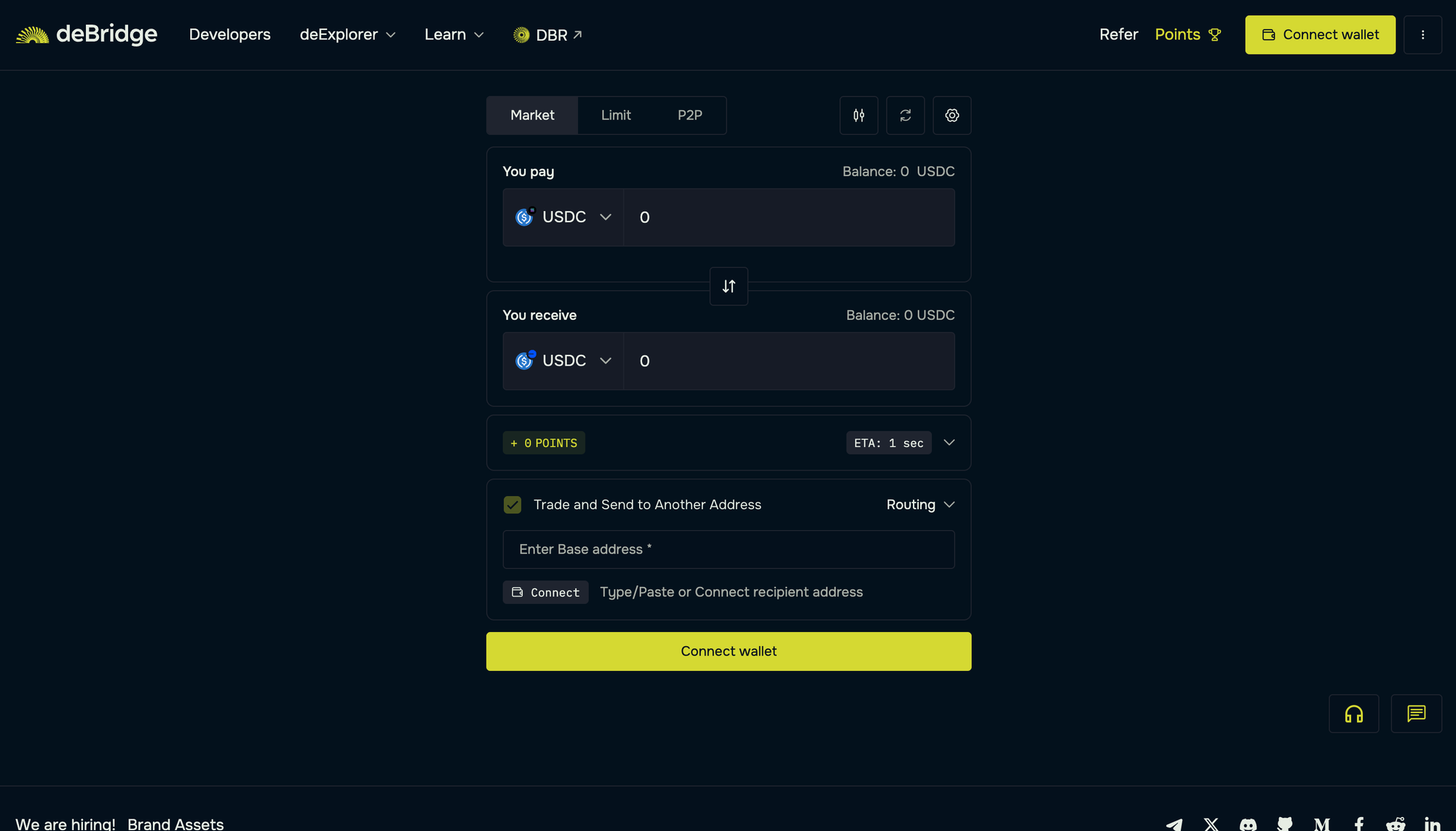
- Connect your Solana wallet as the source and your EVM wallet as the destination. Enter the amount of USDC you wish to bridge.
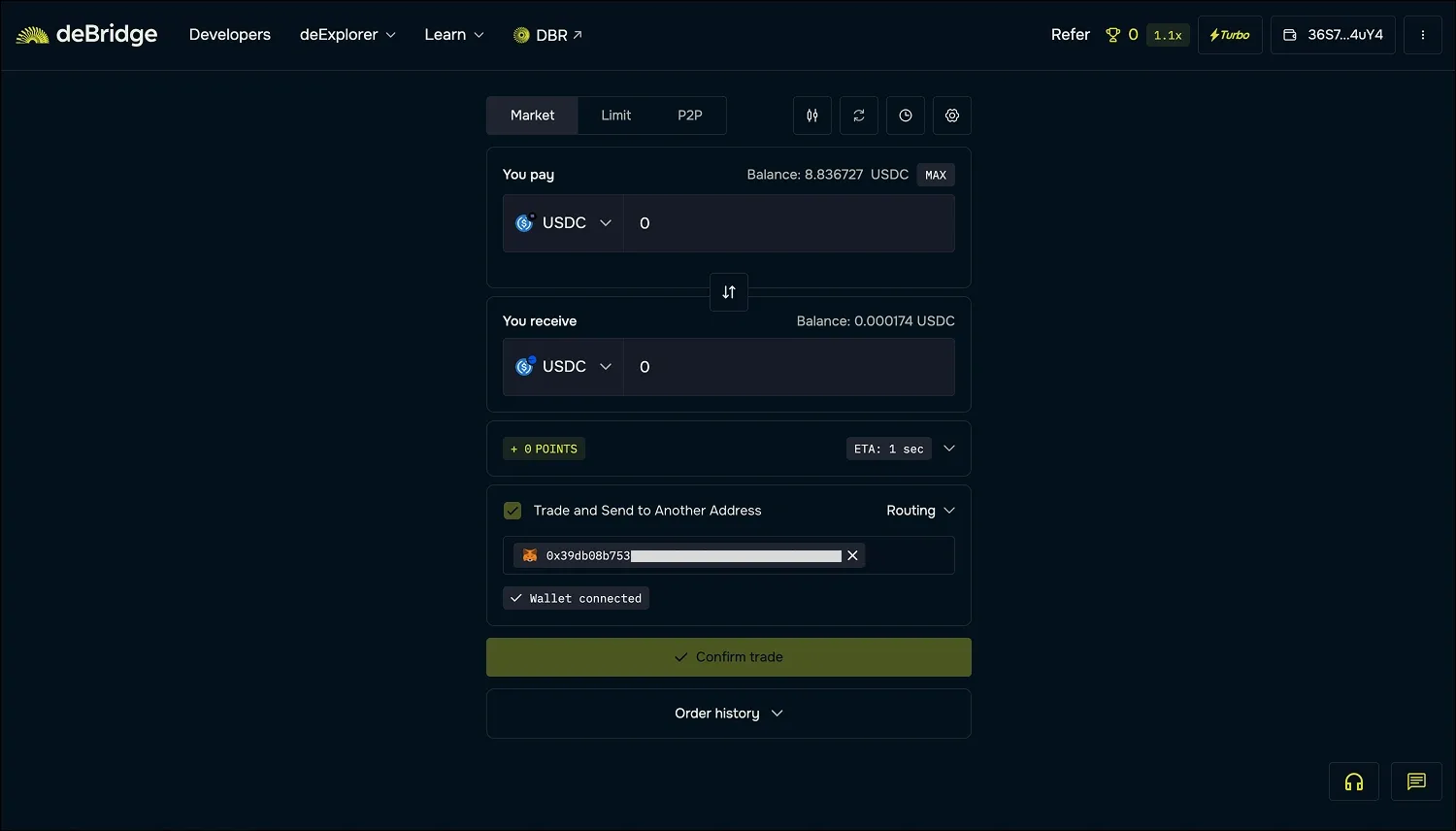
- Review the details and confirm the transaction in your wallet.
The bridging process is simple and only takes a few seconds to complete. You will receive the bridged assets in your Base wallet instantly.