


How to Bridge to Hyperliquid Using deBridge in 2026


Table of Contents
- Key Takeaways
- What is Hyperliquid and Why It Matters for Traders
- Why Users Bridge to Hyperliquid
- Bridging Challenges: Legacy Routes & Why They Fall Short
- What You Need Before Bridging (Wallet Setup)
- Step-by-Step Guide: Bridging to Hyperliquid with deBridge
- How deBridge Compares to Other Hyperliquid Bridges
- Security and Speed: Why deBridge Is Built for High-Volume Transfers
- Developer Access: Onboarding Users Into Hyperliquid via deBridge
- Conclusion
- FAQs (Frequently Asked Questions)
- Related Resources
To bridge to Hyperliquid, connect an EVM wallet to deBridge, select your source chain and asset, choose Hyperliquid as the destination, and confirm. deBridge delivers native Arbitrum USDC to your Hyperliquid account in seconds, ready to trade or deposit.
Hyperliquid is a high-performance L1 that runs its own onchain order book, with a trading experience that rivals centralized exchanges. Before you can trade, you need USDC in your Hyperliquid account. This guide walks through how to bridge and deposit to Hyperliquid with deBridge, step by step, from any chain.
Key Takeaways
- Hyperliquid is a high-performance, gasless L1 with a CEX-like trading experience and deep onchain liquidity.
- HyperEVM expands the ecosystem with smart-contract support, native DeFi access, and unified liquidity.
- Users bridge to Hyperliquid for trading perps and storing crypto assets onchain.
- Legacy bridges are slow, limited, and risky. deBridge enables real-time bridging of native assets with instant finality.
- Developers can integrate deBridge’s API for real-time onboarding into Hyperliquid.
What is Hyperliquid and Why It Matters for Traders
Hyperliquid is a high-performance L1 with a vision of a fully onchain open financial system. It has built a crypto trading exchange with a CEX (centralized exchange) like experience, for transparent onchain orders without compromising end-user experience.
What makes Hyperliquid stand out today is its ecosystem expansion through HyperEVM, an EVM-compatible Layer 1 that unlocks an entirely new universe of possibilities for users. HyperEVM brings smart-contract support and native DeFi infrastructure directly into the Hyperliquid environment.
If you want a deeper look at how this new chain works, check out our guide on what is HyperEVM.
Key features of Hyperliquid
- High-Performance L1 Blockchain: Promises rapid transaction speeds, deep liquidity, and high throughput up to 100,000 orders per second.
- Self-custody: Users maintain full control of their assets while trading, ensuring trust-minimized execution. Learn more about self-custody.
- Community-driven model: Hyperliquid is known for its grassroots community, transparent updates, and product development driven closely by user feedback.
- Onchain Order Book: Offers deep liquidity, transparency, and a better user experience.
- Advanced Features: One-click order execution, limit orders, scale, TWAP, and more.
Why Users Bridge to Hyperliquid
Users bridge to Hyperliquid because it offers a trading environment that combines CEX-level performance with the security and transparency of onchain execution. Here are some key reasons you should know:
- Extremely fast transactions
- Zero gas fees on Hyperliquid
- Unified liquidity across trading and on-chain activity
- Deep liquidity for large position sizes
- Seamless cross-chain entry through solutions like deBridge
Common Use Cases
- Leveraged trading with deep liquidity (100+ pairs)
- Storing spot assets such as BTC, ETH, SOL, HYPE, FARTCOIN, and more
- Participating in the HyperEVM DeFi ecosystem
- Yield strategies on new HyperEVM protocols
- Trading volatile markets with faster settlement
Bridging Challenges: Legacy Routes & Why They Fall Short
Bridging to new ecosystems like Hyperliquid often begins with the Arbitrum Bridge, but it quickly reveals its limitations. Users can only bridge native ETH from Ethereum to Arbitrum, often face slow transaction finality, and a clunky, multi-step user experience. Waiting minutes (or more) for assets to arrive can be frustrating, especially when markets move quickly.
Other bridges attempt to simplify the process of bridging but introduce new risks. Many rely on wrapped assets or liquidity pools, which opens the door to slippage, delays, and even smart contract vulnerabilities. These friction points often lead to user drop-off before bridging is complete.
That’s where deBridge stands apart. With native asset transfers, instant finality, and a seamless one-click UX, it’s the faster, safer, and better way to bridge to Hyperliquid.
What You Need Before Bridging (Wallet Setup)

Before bridging to Hyperliquid with deBridge, make sure your setup is ready to prevent any delays. Here’s a quick checklist to help you get started:
- EVM-Compatible Wallet: Use MetaMask, Rabby, WalletConnect, or any wallet that supports EVM networks.
- ETH for Gas Fees: Ensure your wallet has sufficient ETH to cover transaction costs during the bridging process.
- Access to the deBridge App: Navigate to https://app.debridge.finance and connect your wallet to begin bridging.
- RPC Configuration: It is important to configure your wallet with the appropriate RPC settings. If it’s not already set up, you can easily add the correct network using Chainlist.
Once all is set, you can follow the steps below and bridge to Hyperliquid in a few clicks.
Step-by-Step Guide: Bridging to Hyperliquid with deBridge

Before the integration of Hyperliquid with deBridge, users depended on services like the Arbitrum Bridge to transfer native ETH to the Arbitrum chain and then swap ETH for USDC.
Now, the best Hyperliquid bridge is the fastest. If you want to deposit USDC to start trading or increase your position size, deBridge provides an instant bridging solution to help you bridge any asset on any chain to USDC on the Arbitrum network.
Let’s see how you can bridge USDC to your Hyperliquid account with low fees:
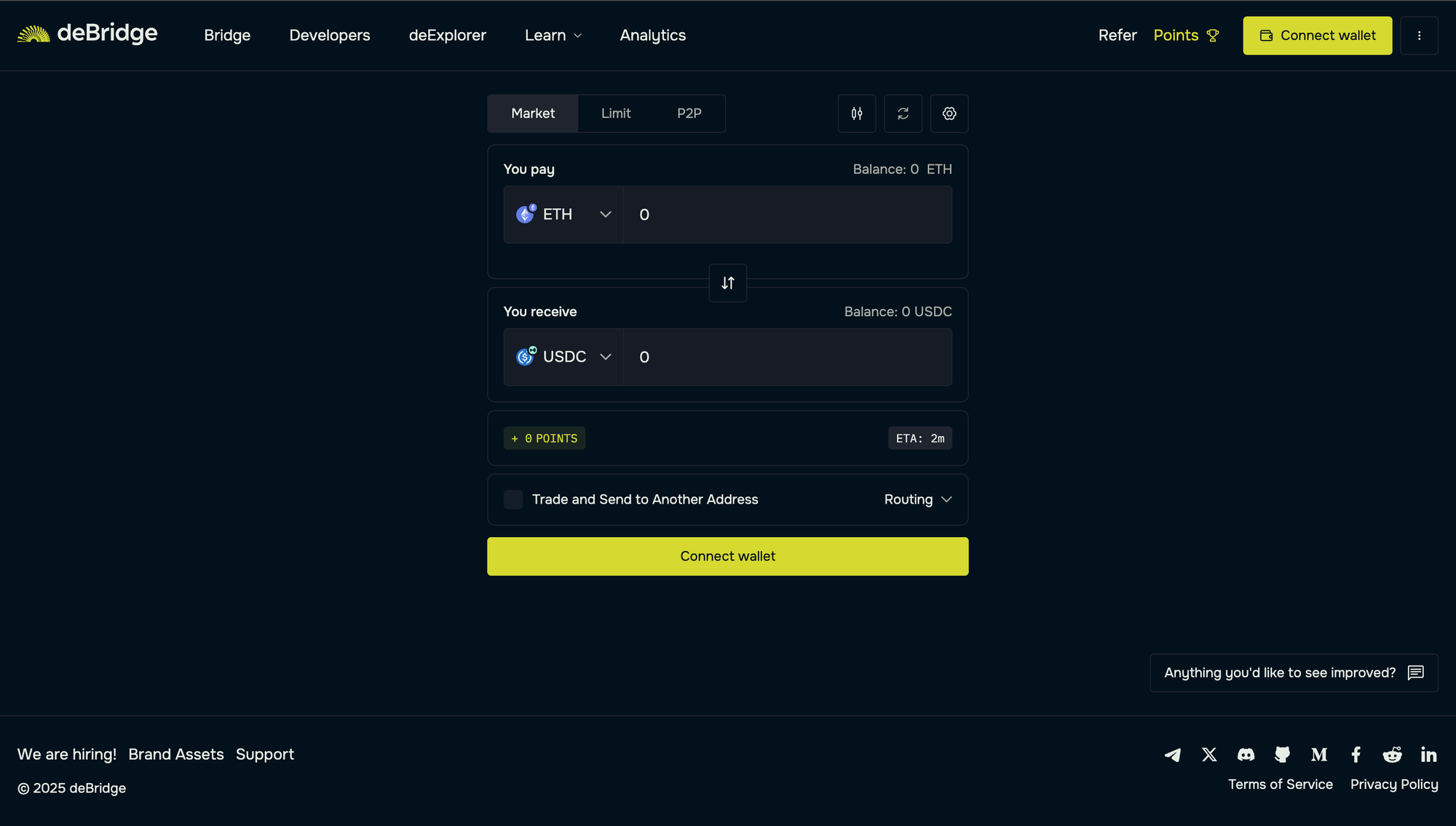
- Visit https://app.debridge.finance
- Select the source chain and asset you’d like to bridge. Here, we will select Ethereum as the source chain and ETH as the asset.
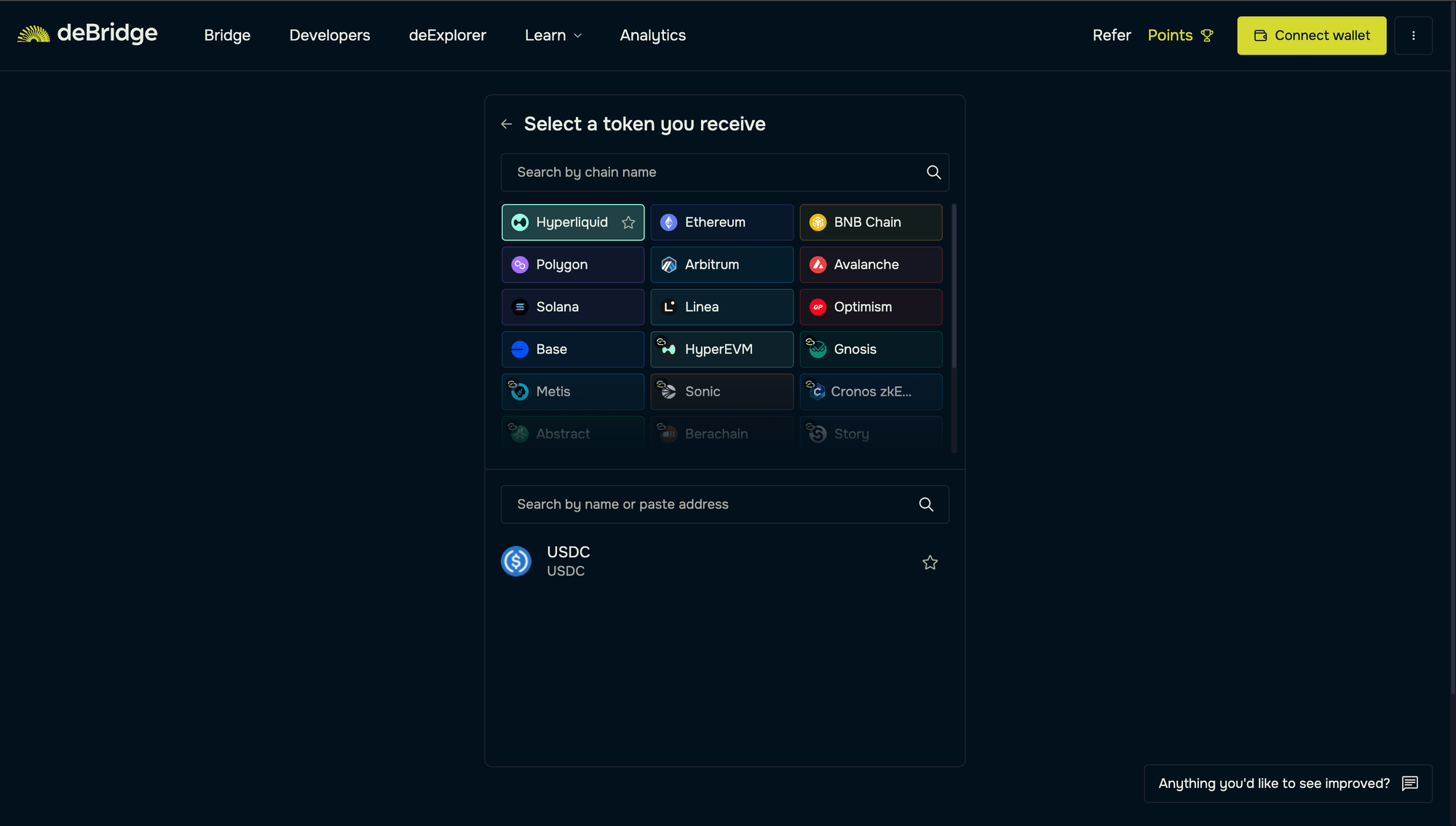
- Next, select the destination chain and asset you’d like to receive. Here, we will select Hyperliquid (Arbitrum network) and it will automatically select USDC on the target chain.
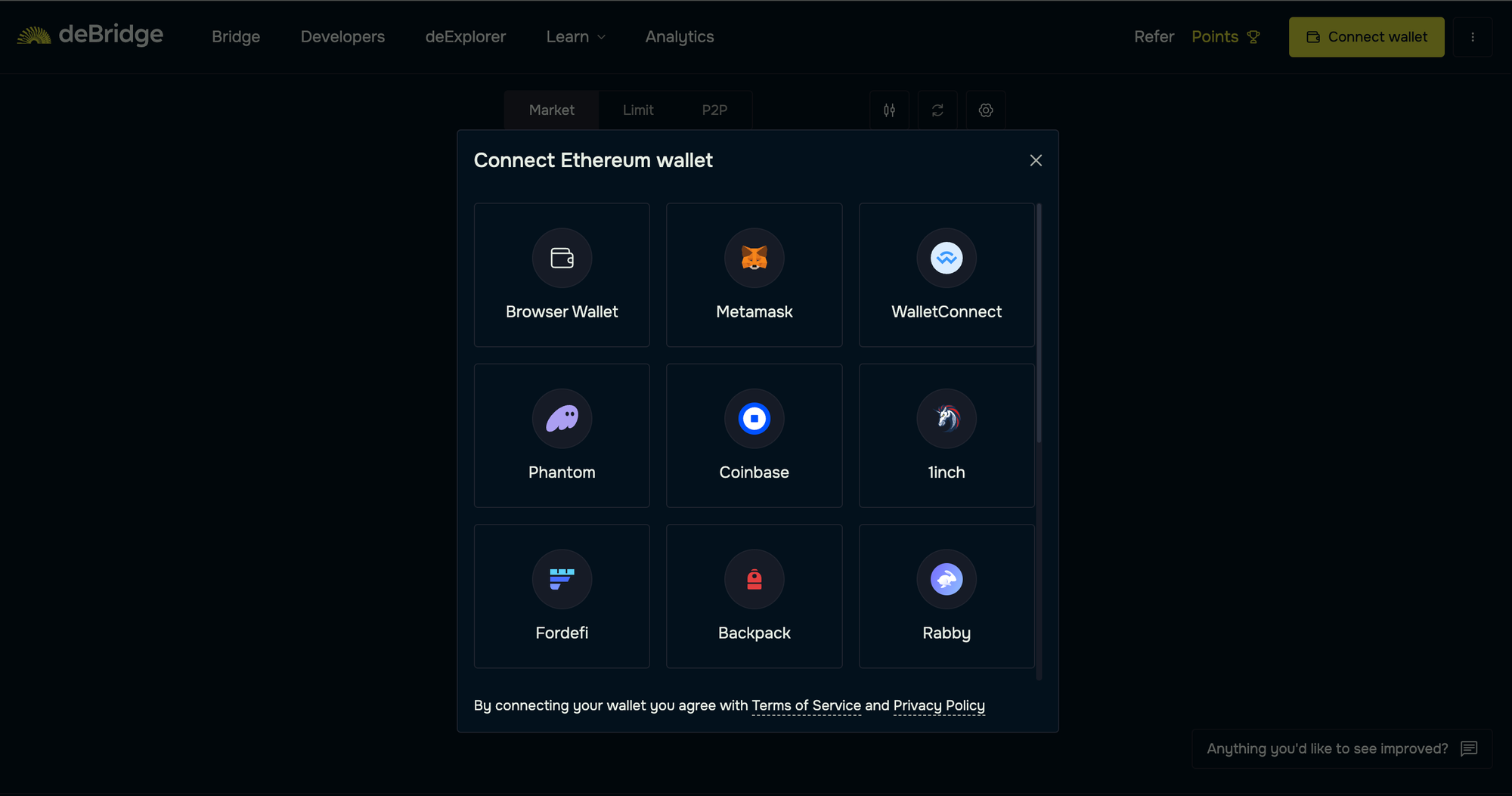
- Connect your EVM wallet as the source and destination.
- Enter the ETH quantity and review the transaction details.
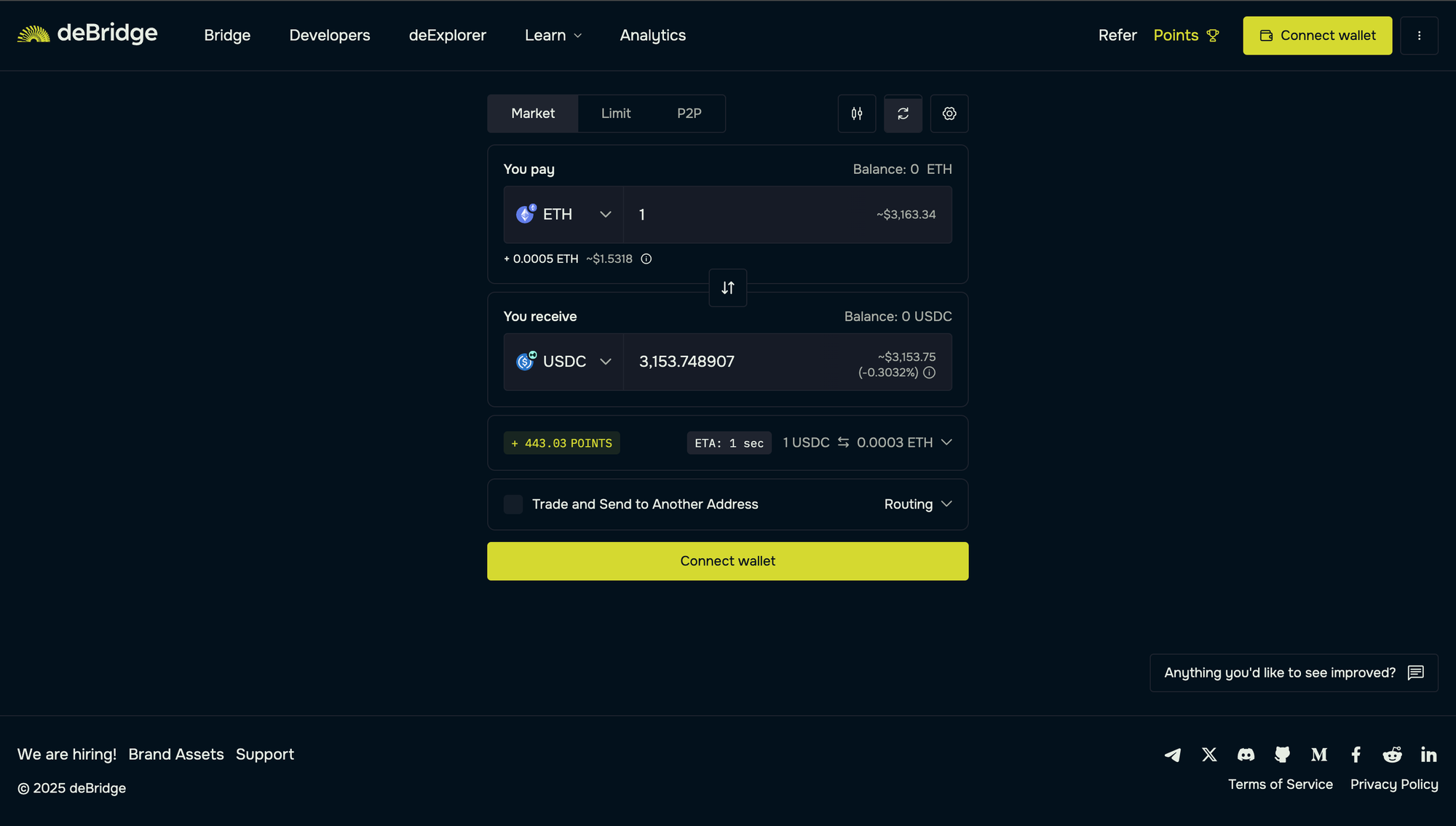
- Confirm trade and sign the ensuing transactions to receive native arbitrum USDC in your Hyperliquid account.
Pro Tips
- Make sure you have sufficient ETH in your destination chain (Arbitrum) for the transaction to be completed.
- To save on ETH gas costs, avoid bridging during periods when Ethereum gas prices are high.
This process takes a few seconds to complete and reflects the bridged assets (USDC) in your Hyperliquid account. Technical users can also inspect the transaction(s) on the Arbitrum mainnet explorer.
Bridge from Solana to Hyperliquid
While most bridges help you move funds from EVM to EVM, deBridge bridges directly from Solana to Hyperliquid. Select Solana as your source chain, pick SOL or any Solana asset, choose Hyperliquid as the destination, and deBridge delivers native Arbitrum USDC to your account in seconds.
The same path works from Base, BNB Chain, and 20+ other networks. Wherever your liquidity lives, you bridge and deposit to Hyperliquid in one flow.
How deBridge Compares to Other Hyperliquid Bridges
The Arbitrum native bridge isn't your only option, and most traders weigh a few routes before moving funds. Here's how deBridge stacks up against the bridges people most often consider for Hyperliquid.
Arbitrum Bridge: The native Arbitrum Bridge is slow and clunky, with limited asset support. It only moves ETH from Ethereum to Arbitrum, then leaves you to swap into USDC yourself. It's slow, multi-step, and built for one chain.
deBridge: deBridge moves any asset from any of 20+ chains and delivers native Arbitrum USDC straight to your Hyperliquid account, usually in 1-2 seconds. No wrapped assets, no liquidity pools, no route roulette. Just native settlement with guaranteed execution, even at 6 and 7-figure sizes.
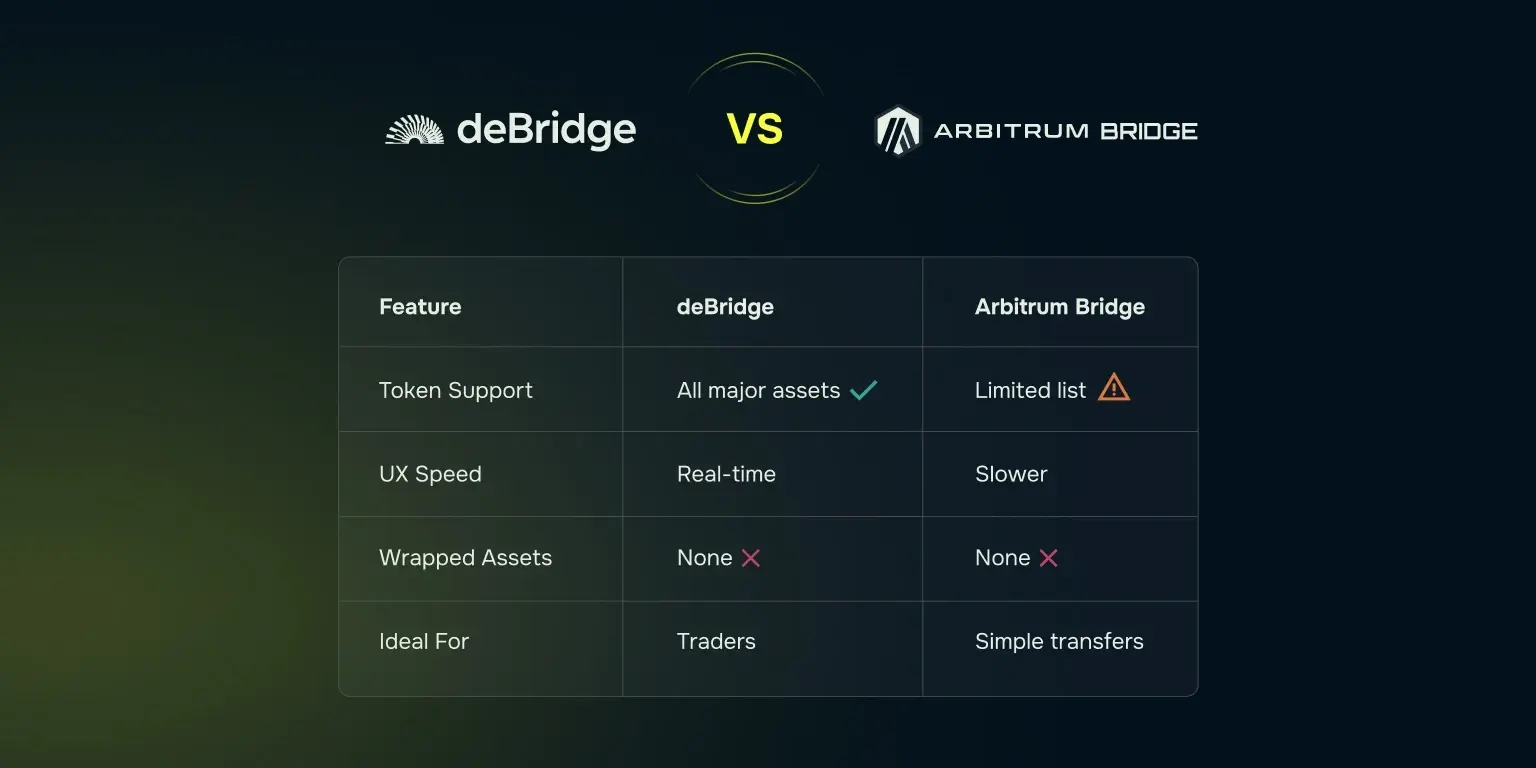
deBridge: The gateway to Hyperliquid
deBridge has processed over $17 billion in total volume and has helped nearly a million users move across 25+ chains. With real-time cross-chain routing, deBridge offers a superior alternative to native or legacy bridges, such as the Arbitrum Bridge, providing deep liquidity, guaranteed execution, and a better user experience.
- 0-TVL architecture
- Native asset bridging
- Slippage-free transfers
Security and Speed: Why deBridge Is Built for High-Volume Transfers
deBridge prioritizes speed without compromising on security during the order lifecycle. Unlike traditional bridges relying on wrapped assets or pooled liquidity (prime targets for exploits), deBridge uses a 0-TVL architecture that avoids liquidity pools and eliminates attack surfaces.
The deBridge protocol has undergone over 30 security audits by leading firms, including Halborn and Zokyo, and has maintained a clean record of zero exploits to date. It also hosts a $200,000 bug bounty program that has yet to be claimed, a testament to the app's security.
Today, many well-known crypto projects like Phantom, Solflare, Jupiter Exchange, Infinex, and more trust deBridge. To summarize all the above points:
- 0-TVL architecture = No liquidity pools
- 30+ audits across the deBridge protocol
- $200K bug bounty (never claimed)
- Trusted by leading protocols and wallets
- Capable of 6-7 figure transfers with no slippage
Developer Access: Onboarding Users Into Hyperliquid via deBridge

deBridge gives developers an option to integrate real-time bridging with a plug-and-play SDK and API, making it easy to move any asset or message across chains.
deBridge is the bridge backed by DeFi that helps you trade any asset at lightspeed. It enables real-time movement of assets and information across the DeFi landscape. It is designed keeping developers in mind, making it easy to add the deBridge widget or API within the dApp.
With real-time settlement and bridging of native assets, it only makes sense for developers to use the deBridge SDK and REST API for onboarding users into Hyperliquid via deBridge. It also helps you earn fees for each transaction on your platform, along with an option for affiliate tracking.
To add advanced cross-chain functionalities to the applications, read our article on Real-time DeFi data with deBridge Hooks.
Conclusion
Are you ready to experience seamless, gasless trading on one of the fastest-growing DEXs? Bridge to Hyperliquid using deBridge at lightning-fast speed and unlock instant access to high-speed, Arbitrum-native trading with zero gas fees. Whether you’re moving ETH, USDC, or any other asset, deBridge ensures fast, secure, and safe transfers without any delays.
For developers and partners, deBridge also offers powerful tools like our integration widget and SDK, making it easy to embed cross-chain functionality directly into your app or platform. As Hyperliquid continues to lead in performance and UX, deBridge is the best choice for anyone looking to make onboarding smooth for their users.