


How AI Agents Trade Crypto in 2026?


Table of Contents
- What Are AI Agents in Crypto?
- How Agents Perform Cross-Chain Execution
- How Agents Actually Execute a Trade
- The Security Question For Every Trader
- What's Next for AI Agents
- Related Resources
Crypto never sleeps.
If you’re an active user on X, chances are you’ve already seen this statement. Markets run around the clock, liquidity shifts between chains in seconds, and a single headline can make or break prices. For years, the answer was simple automation: bots that followed rigid rules. Buy at X, sell at Y, repeat.
That era is over now.
In 2026, AI agents have moved well beyond scripted bots. They reason, plan multi-step strategies, and execute trades across blockchains without waiting for a human to click "confirm" on every step. As the infrastructure beneath these agents matures, the gap between manual trading and autonomous execution is only widening.
This guide breaks down how AI agents actually trade crypto today, what changed to make this possible, and why cross-chain execution infrastructure like deBridge sits at the center of the shift.
What Are AI Agents in Crypto?
AI agents are systems that can understand goals, make decisions, and take actions on your behalf. In crypto, that means you are not telling the agent to do something, but it is actually doing it on its own.
Until recently, AI could help you research tokens, analyze trends, or suggest trades. But execution remained entirely manual. With new infrastructure layers emerging, AI agents can now move capital, route trades, and manage complex DeFi positions across ecosystems in real time.
What Makes a Crypto AI Agent Different From a Trading Bot?
Traditional trading bots operate on conditional logic. If price drops below a threshold, buy. If RSI crosses above 70, sell. These trading bots do not understand context.
AI agents work differently by processing real-time price feeds, onchain data, social sentiment, and macroeconomic signals simultaneously. They use machine learning to recognize patterns across these inputs and adjust strategies on the fly.
The practical difference shows up in execution. A trading bot might execute a swap on a single DEX. An AI agent can evaluate liquidity across multiple chains, identify that splitting an order between Arbitrum and Base produces less slippage, route the transactions accordingly, and handle bridging between chains as part of a single workflow.
That last part, the cross-chain piece, is where things get interesting.
How Agents Perform Cross-Chain Execution
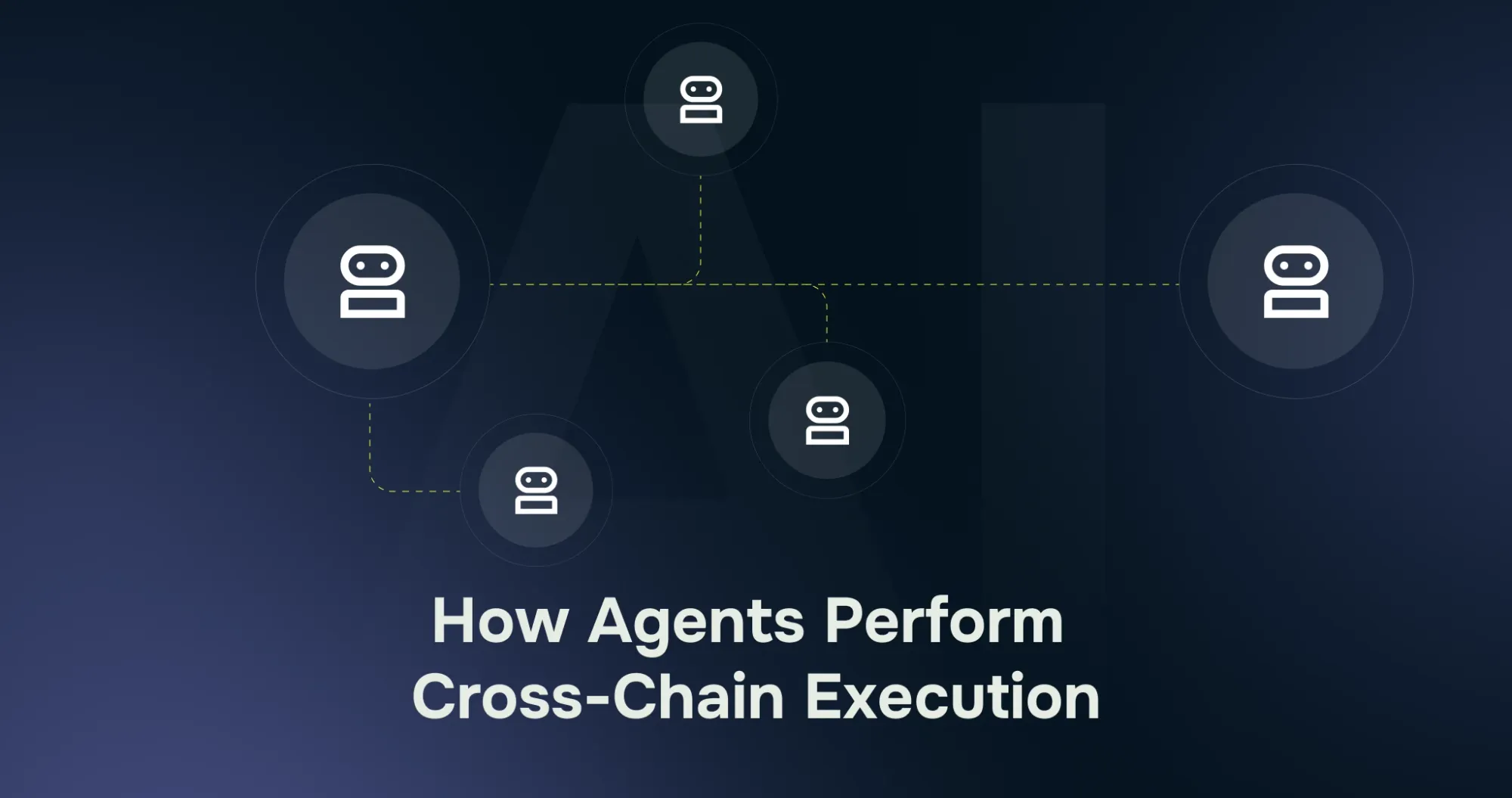
DeFi liquidity is fragmented across multiple blockchains. The best price for a token swap might be on Solana. The staking yield you want might live on Ethereum. Your USDT might be sitting on BNB Chain.
For a human trader, consolidating assets across these networks involves multiple interfaces, wallet connections, bridge approvals, and gas payments in different native tokens. It is slow, error-prone, and expensive.
deBridge MCP
AI agents compress this entire workflow. Using the deBridge MCP, AI agents can quote routes, compare fees, and execute cross-chain swaps and bridges across 23+ blockchains, including all major EVM chains and Solana.
The protocol uses a 0-TVL, intent-based architecture, meaning liquidity is never locked in pools. Assets transfer natively, with deterministic execution that accounts for fees and gas costs upfront, so the quote an agent receives is the outcome it gets.
Vibe Trading
deBridge calls this "Vibe Trading."
Instead of managing trades manually, you express an intent in natural language, and the agent translates it into optimized onchain execution. It works with Claude, Cursor, Copilot, and 35+ other agent environments, making it one of the most widely integrated execution layers for agentic trading.
What matters is no longer how you trade, but what outcome you want.
How Agents Actually Execute a Trade
Let’s walk through a real example. Say you tell an agent: "I want to move $5,000 of ETH from Ethereum to Solana and swap it into SOL for the best rate."
Here is what happens:
The agent queries the deBridge MCP server for available routes between Ethereum and Solana. It receives quotes that include total costs, execution time, and slippage projections. The agent evaluates whether a direct bridge or a multi-hop route (e.g., ETH to USDC on Ethereum, bridge USDC to Solana, then swap USDC to SOL) yields a better outcome. It selects the optimal path and prepares the transaction.
At no point does the agent take custody of your funds. The deBridge MCP server generates transaction payloads for your wallet to sign. This non-custodial model, backed by 30+ security audits with zero exploits across $20B+ in processed volume, is what separates production-grade infrastructure from experimental tooling.
After you approve, the agent monitors the transaction through deBridge's explorer. If something fails, retries are handled automatically.
The Security Question For Every Trader
With AI agents managing increasingly complex strategies, the attack surface has expanded. In 2026, we have already seen incidents where compromised agent memory and insecure protocol connections led to significant losses. How agents remember context, connect to tools, and route transactions has become a prime target.
This is why the infrastructure an agent connects to matters as much as the agent itself. deBridge's architecture addresses several of these concerns by design. The 0-TVL model eliminates the honeypot risk of locked liquidity pools. MEV-aware routing protects against sandwich attacks.
The MCP server operates in read-only mode by default, meaning it cannot execute without explicit user approval. And because assets are delivered natively (not as wrapped tokens), there is no wrapped-asset risk.
For traders evaluating which execution layer to trust, the track record matters. deBridge has processed over $20 billion in volume, completed 30+ security audits with zero exploits, and supports 23+ chains with native asset delivery and zero slippage on quoted routes.
What's Next for AI Agents
The current wave of AI agent trading is still early. Most retail users interact with agents through simple prompts: swap this token, bridge that asset, check this price. As we progress, we’ll see fully autonomous portfolio management, where agents rebalance across chains, harvest yield, and adjust risk exposure based on real-time conditions.
The protocols that win will be the ones that give agents the most reliable, composable, and secure execution layer. deBridge is building exactly that: open-source, non-custodial infrastructure that treats AI agents as first-class users of DeFi.
If you are building agentic workflows or exploring what AI can do for your portfolio, the starting point is agents.debridge.com. Install the MCP server, connect your preferred AI tool, and start trading with intent instead of clicks.