


Top 8 Cross-Chain Bridges in 2026: Speed, Security, and Fees Compared


Table of Contents
- Top Features to Look For in a Cross-Chain Bridge
- Overview Table of Cross-Chain Bridges
- The 8 Best Cross-Chain Bridges Reviewed
- Choose the Best Cross-Chain Bridge for Your Needs
- Frequently Asked Questions (FAQs)
- Related Resources
If you've ever tried moving assets between Ethereum, Solana, Tron, or any Layer 2 blockchain, you know that picking the wrong bridge can cost you. Slippage eats into large swaps. Pool-based bridges hold hundreds of millions in locked value, making them prime targets for exploits. Chain support is another issue, as half the options don’t properly support either Solana or Tron.
This guide compares the 8 best cross-chain bridges in 2026, breaking down speed, security, fees, and chain coverage to help you find the right fit for your next swap.
Our Pick for the Best Cross-Chain Bridges in 2026
- deBridge
- Stargate
- Across
- Wormhole
- LayerZero
- Synapse
- Relay
- Squid
Top Features to Look For in a Cross-Chain Bridge
Not all bridges are built the same. Many rely on pooled liquidity, centralized custodians, or wrapped assets, creating risks for users. This section highlights features to consider before selecting a bridge for your cross-chain bridging.
- Execution Speed: Some bridges confirm transactions in seconds while others take a few minutes, depending on how they handle finality. When markets are moving fast, that gap makes a real difference.
- Security Model: This is the most important aspect. Bridges that hold large liquidity pools are prime targets for exploits. Bridges with fewer trust assumptions, like intent-based or 0-TVL designs, carry less exploit risk because there's simply less to steal.
- Slippage and Liquidity: Pool-based bridges expose you to slippage on larger orders. If you're swapping anything beyond a small amount, look for bridges that guarantee your rate at the time of the quote, i.e., receive exactly what you see at the time of swap.
- Supported Chains and Assets: If you're active on Solana, Tron, newer L2s, or non-EVM chains, check compatibility first. Some bridges do not support the Tron network.
- Fee Transparency: Some bridges look cheap on the surface, but they bury costs in bad exchange rates or inflated gas prices. The best bridges show you the complete breakdown with full cost before you confirm the transaction.
Overview Table of Cross-Chain Bridges
The 8 Best Cross-Chain Bridges Reviewed
deBridge
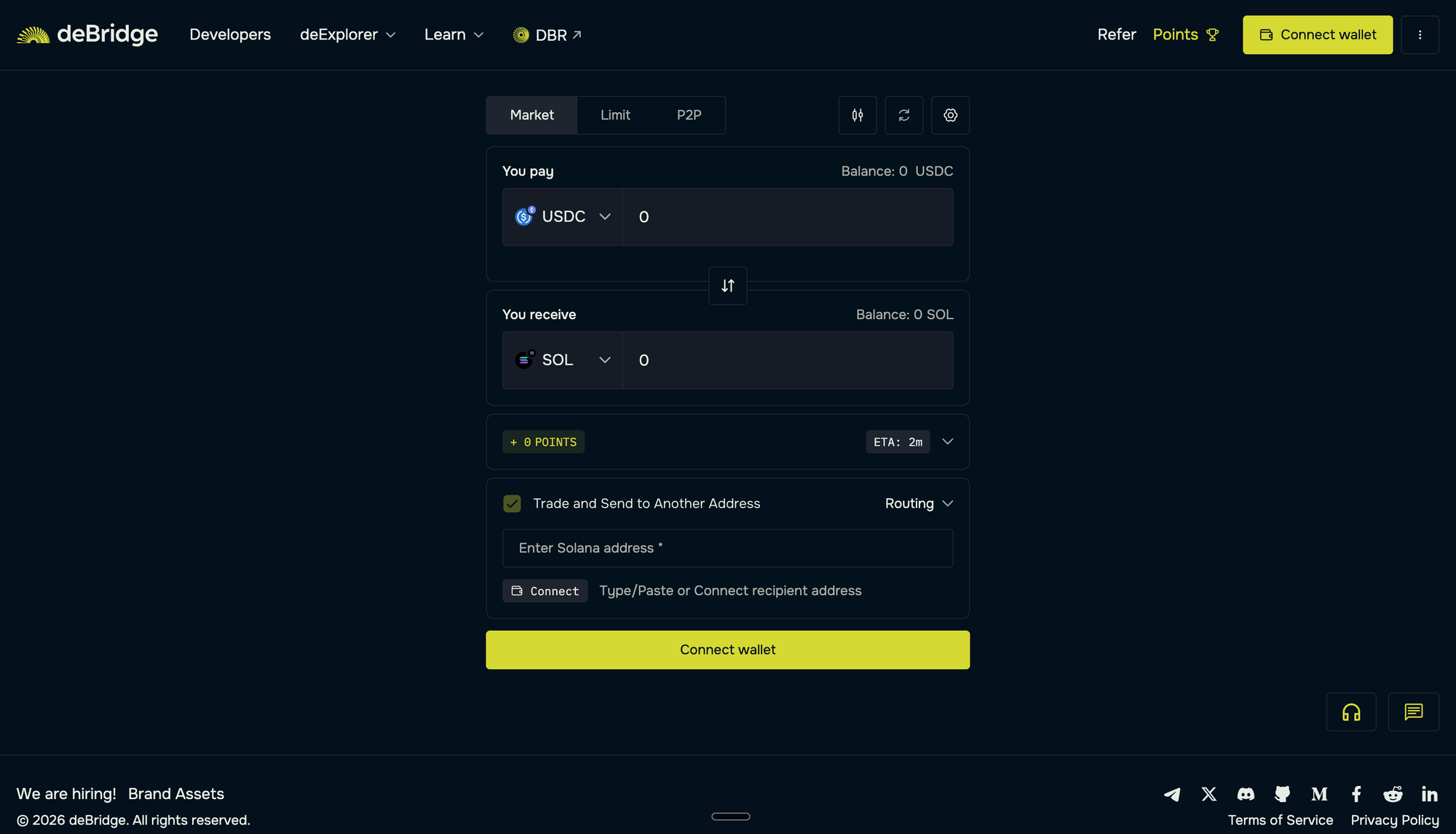
deBridge is a cross-chain protocol that takes a fundamentally different approach to bridging. It uses a 0-TVL, intent-based architecture, which means it doesn't lock assets in liquidity pools. Instead, professional market makers compete to fill your order at a guaranteed rate. You get native tokens on the destination chain, not wrapped versions, and you don't have to worry about pool depth or slippage.
It supports EVM chains, Solana, and Tron natively, with most transactions completing in 1 to 4 seconds.
Top Features
- The 0-TVL architecture eliminates the risk of pooled-liquidity exploits.
- What you see is what you get, irrespective of the trade size.
- Native Solana support with fast settlement, not a wrapped workaround.
- DLN (deBridge Liquidity Network) creates competition among market makers for tighter spreads.
- Receive native tokens on the destination chain every time.
Pricing
deBridge charges a flat fee and a variable fee of 4 bps, paid in the input token. The full cost is displayed before you confirm your transaction.
Stargate
Stargate is a composable liquidity transport protocol built on top of LayerZero. It pools liquidity across chains to enable native-asset transfers between EVM networks.
Top Features
- Unified liquidity pools with guaranteed finality on the source chain.
- Native asset transfers on supported routes, no wrapped tokens involved.
- Composable with other DeFi protocols through LayerZero messaging.
- Supports Ethereum, Arbitrum, Optimism, BNB Chain, Avalanche, and more.
Pricing
A small per-transaction fee plus a rebalancing fee that fluctuates with pool utilization. Generally predictable for standard-size transfers.
Across
Across uses an intent-based model with optimistic verification powered by UMA's oracle. Relayers front capital on the destination chain and get reimbursed after a short verification window, resulting in fast EVM-to-EVM settlement.
Top Features
- Optimistic relay execution that typically settles in under 1 minute.
- Intent-based design where relayers compete to fill orders.
- Clean security track record with no major exploits to date.
Pricing
Relayer fees plus a small LP spread. Costs vary by route and size.
Wormhole
Wormhole started in the Solana ecosystem and has grown into one of the most widely connected cross-chain protocols, now supporting over 30 networks. It works as both a token bridge and a general messaging layer, secured by 19 guardian validators.
Top Features
- Over 30 supported chains, spanning EVM and non-EVM ecosystems.
- General messaging protocol that goes beyond simple token transfers.
- NTT (Native Token Transfers) framework for cross-chain token deployments.
- Active governance and ecosystem fund supporting builders.
Pricing
Low protocol-level fees per transfer. Destination-chain gas is typically the main cost for end users.
LayerZero
LayerZero is more infrastructure than a bridge. It's an omnichain messaging protocol that other applications build on. Stargate, OFTs (Omnichain Fungible Tokens), and dozens of dApps all run on LayerZero under the hood.
Top Features
- Configurable security through Decentralized Verifier Networks (DVNs).
- Powers the OFT standard for native multi-chain token deployments.
- Broad chain support spanning EVM, Solana, Aptos, and other ecosystems.
- Developer-focused with extensive SDK and documentation.
Pricing
Fees are determined by the apps built on LayerZero, not by the protocol itself. Your cost depends on which dApp you're using.
Synapse
Synapse is a cross-chain bridge and messaging protocol that combines AMM liquidity pools with optimistic verification. If you need to bridge to a less common chain, Synapse is often one of the few options available.
Top Features
- Wide chain coverage, including many smaller and newer networks.
- AMM-based swaps that allow cross-chain token exchanges, not just same-asset transfers.
- Multi-asset support extending well beyond stablecoins and blue-chip tokens.
- Synapse Chain in development as an optimistic cross-chain coordination layer.
Pricing
AMM swap fee plus a bridge transaction fee. Slippage can apply to larger orders depending on pool depth.
Relay
Relay is a lightweight, intent-based bridge built for speed. It uses relayers who front assets on the destination chain to settle your order quickly, and it works well for small to mid-size transfers across EVM chains.
Top Features
- Intent-based matching with competitive relayer execution.
- Clean, simple UX designed for quick bridging.
- Minimal smart contract complexity, reducing attack surface.
Pricing
Relayer spread per transaction. Competitive for smaller transfers, though costs may widen on larger orders or thinner routes.
Squid
Squid is a cross-chain routing protocol powered by Axelar's messaging network. It acts as a bridge aggregator, finding the best route across chains and DEXes and bundling everything into a single transaction.
Top Features
- One-click cross-chain swaps that combine bridging and DEX routing in a single step.
- Aggregates liquidity across multiple sources for better pricing.
- Secured by Axelar's decentralized validator set.
- Supports any-token-to-any-token swaps across connected chains.
Pricing
Aggregated route fees that vary by path. You'll pay bridge fees plus DEX swap fees along the selected route, all shown upfront before you confirm.
Choose the Best Cross-Chain Bridge for Your Needs

The right bridge depends on what you're actually trying to do.
If you want guaranteed rates, zero slippage, and native Solana support, deBridge is the most complete option. Its 0-TVL model means you're not exposed to pool-based risks, and you always receive native assets.
If your priority is frequent smaller swaps between EVM and L2s, Relay is a good choice, offering a simple UX designed for quick bridging.
If you need the widest chain coverage and can tolerate longer confirmation times, Wormhole and Synapse support the most networks. And if you want routing handled for you in one click, Squid abstracts it all.
For most users who want the best combination of speed, security, and real-time delivery of native assets, deBridge is the strongest choice in 2026.