


Best DEXs for Swapping Tokens in 2026


Table of Contents
- Key Takeaways
- Understanding DEXs
- Cross-Chain DEX vs. Onchain DEX
- Best DEXs for Swapping Tokens
- How to Choose the Best DEX
- Why deBridge Is the Best Choice for Cross-Chain Swaps
- Frequently Asked Questions (FAQs)
- Related Resources
Decentralized exchanges have become essential infrastructure for crypto traders. Whether you are swapping stablecoins on Ethereum, trading memecoins on Solana, or moving assets between entirely different blockchains, there is a DEX built for the job.
Not all DEXs work the same way, though. Some focus on swaps within a single chain, while others specialize in cross-chain execution. The right choice depends on what you are trading, where your assets live, and how much you value speed, cost, and security.
This article compares the best DEXs for swapping tokens in 2026, covering both samechain and cross-chain options, and helps you choose the right one for your needs.
Key Takeaways
- DEXs fall into two categories: samechain (single-chain swaps) and cross-chain (swaps between different blockchains), serving different use cases.
- deBridge is the top choice for cross-chain swaps, offering zero slippage, no pooled-liquidity risk, and near-instant native-asset delivery across 26+ chains.
- Onchain aggregators like Jupiter (Solana) and 1inch (EVM) find the best rates by scanning multiple DEX liquidity sources.
- Security, liquidity depth, fee structure, and supported tokens are the key factors when choosing a DEX.
- For developers, API and SDK availability can determine which DEX integrates best into your product.
Understanding DEXs
A decentralized exchange lets you swap tokens directly from your wallet without a centralized intermediary. Trades execute through smart contracts, and you maintain custody of your assets throughout the process. This removes counterparty risk and eliminates the need for account creation, KYC, or deposit/withdrawal steps.
DEXs offer several advantages over centralized platforms: self-custody of funds, permissionless access, transparency through onchain settlement, and access to a broader range of tokens, including newly launched assets that centralized exchanges have not yet listed.
Cross-Chain DEX vs. Onchain DEX
Onchain DEXs handle swaps within a single blockchain. If you want to trade ETH for USDC on Ethereum, or SOL for a memecoin on Solana, an onchain DEX like Uniswap or Jupiter is purpose-built for that. Execution is fast, gas costs are predictable, and slippage depends on pool depth.
Cross-chain DEXs handle swaps between different blockchains. If you want to move ETH on Ethereum to SOL on Solana in a single transaction, you need a cross-chain protocol like deBridge. Cross-chain swaps are more complex because they involve coordination across separate networks, and the execution model matters significantly.
Pool-based bridges introduce slippage and wrapped token risk, while intent-based protocols like deBridge eliminate both by using competing solvers to fill orders with native assets.
Best DEXs for Swapping Tokens
Here are eight of the best DEXs for swapping tokens in 2026, covering both samechain and cross-chain options.
deBridge - Best for Near-Instant Cross-Chain Swaps
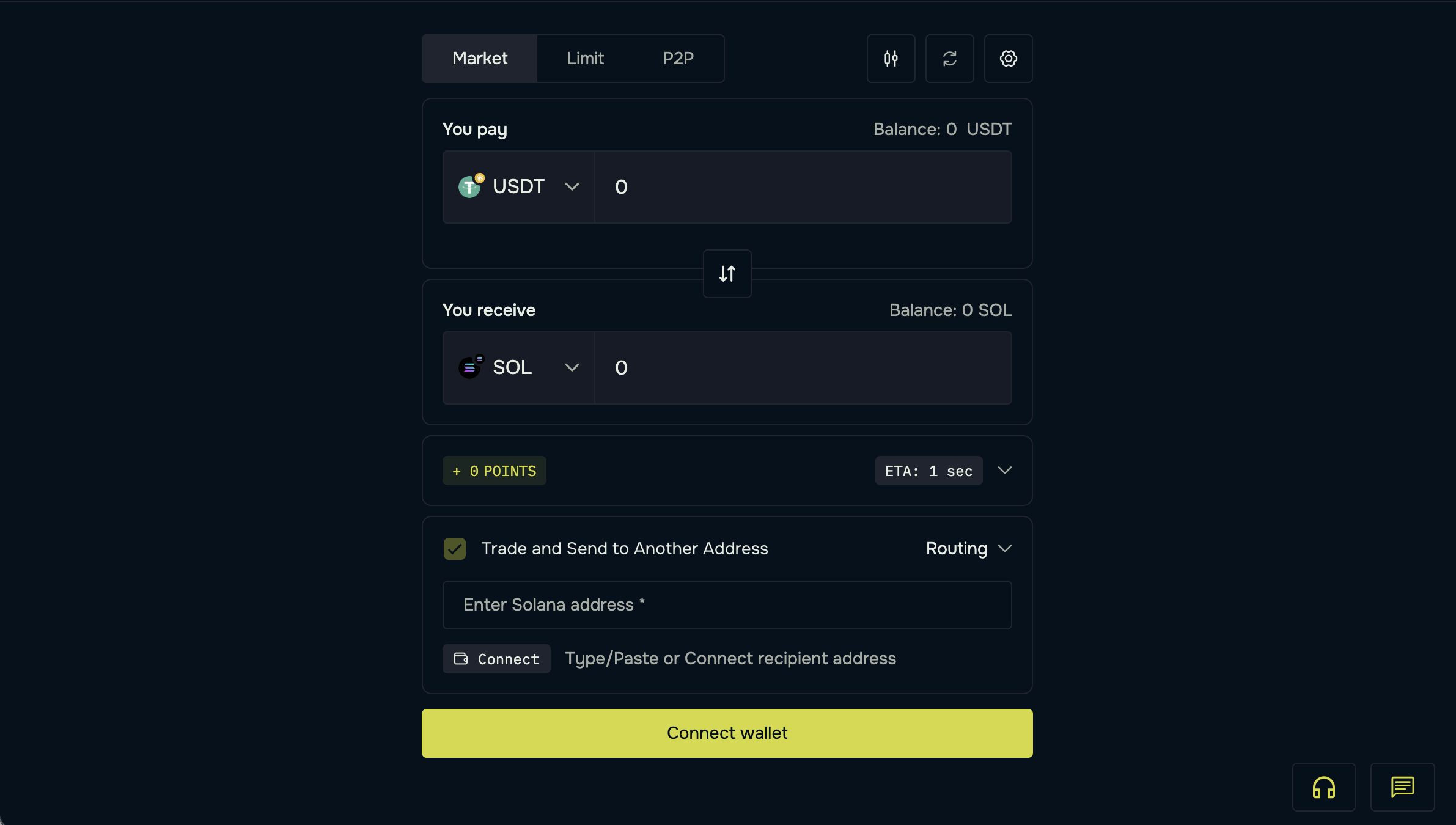
deBridge is a cross-chain swap protocol that uses a 0-TVL (zero total value locked) architecture. Rather than pooling liquidity in smart contracts, deBridge relies on a network of competing solvers who fulfill cross-chain orders directly. This design eliminates slippage, removes wrapped token risks, and delivers native assets to your destination wallet in seconds.
The protocol connects 26+ blockchains, including Ethereum, Solana, BNB Chain, Tron, Base, Arbitrum, and Hyperliquid. It has processed over $20 billion in volume with zero protocol exploits, backed by 30+ security audits from firms like Halborn and Zokyo.
Supported tokens: Millions, including ETH, SOL, USDC, USDT, BNB, ARB, DOGE, HYPE
Supported wallets: MetaMask, Phantom, Rabby, Trust Wallet, OKX Wallet, Coinbase Wallet, Ledger, Trezor, and more
Fees: Very low variable fee, no interface fee
Developer tools: SDK, REST API, cross-chain widgets, deBridge Hooks
Uniswap
Uniswap is the largest AMM-based DEX, primarily serving the Ethereum ecosystem. It supports swaps on Ethereum mainnet plus major L2s like Arbitrum, Base, Optimism, and Polygon.
Supported tokens: Thousands of ERC-20 tokens across Ethereum and L2s
Supported wallets: MetaMask, Coinbase Wallet, WalletConnect, Rabby
Fees: 0.01% to 1% per pool tier (no interface fee)
Developer tools: Uniswap SDK, smart contract APIs, V4 hooks framework
Jupiter
Jupiter is the leading DEX aggregator on Solana, routing over 50% of the network's swap volume. Its Metis engine scans liquidity across Raydium, Orca, Lifinity, and dozens of other Solana DEXs to deliver optimal pricing.
Supported tokens: Thousands of SPL tokens on Solana
Supported wallets: Phantom, Solflare, Backpack, Ledger (via Solana wallet interfaces)
Fees: 0.1% platform fee plus underlying DEX fees
Developer tools: Jupiter API, Terminal widget, Payments API
1inch
1inch is a multi-chain DEX aggregator supporting 13+ ecosystems, including Ethereum, Arbitrum, Base, BNB Chain, Polygon, Avalanche, and Solana.
Supported tokens: Thousands across 13+ chains
Supported wallets: MetaMask, Rabby, Phantom, Ledger, Trezor, Coinbase Wallet, OKX Wallet
Fees: No platform fee (users pay underlying pool fees and gas)
Developer tools: 1inch API, Fusion SDK, developer portal
PancakeSwap
PancakeSwap is the dominant DEX on BNB Chain, offering AMM pools with V3 concentrated liquidity and multiple fee tiers. It has expanded to Ethereum, Arbitrum, Base, zkSync, Linea, and Solana.
Supported tokens: Thousands across 8 chains
Supported wallets: MetaMask, Trust Wallet, Coinbase Wallet, WalletConnect
Fees: 0.01% to 0.25%, depending on pool tier
Developer tools: PancakeSwap SDK, smart contract APIs
Curve Finance
Curve is an AMM optimized for swaps between assets that should hold similar value, such as stablecoins, wrapped Bitcoin pairs, and liquid staking derivatives.
Supported tokens: Stablecoins, wrapped BTC, LSTs, and crvUSD across Ethereum and multiple L1/L2 networks
Supported wallets: MetaMask, WalletConnect, Ledger, Trezor
Fees: 0.01% to 0.04% per pool
Developer tools: Curve API, pool registry, integration docs
SushiSwap
SushiSwap operates across 40+ blockchains with its RouteProcessor engine aggregating liquidity from its own pools and external DEX sources.
Supported tokens: Thousands across 40+ chains
Supported wallets: MetaMask, WalletConnect, Coinbase Wallet, Rabby
Fees: 0.3% standard pool fee (V2); variable for V3 concentrated liquidity pools
Developer tools: Sushi SDK, RouteProcessor API
Best DEXs for Swapping Tokens: Overview
How to Choose the Best DEX
With so many options for swapping crypto, choosing the right platform depends on your specific needs:
Security: It should be the #1 priority when selecting a DEX. Check the platform's audit history, whether it has suffered exploits, and how long it has been operating. Protocols like deBridge, with 30+ audits and zero exploits, represent the gold standard for cross-chain security.
Type of swap: Onchain and cross-chain DEXs serve fundamentally different purposes. If your tokens are already on the samechain, an onchain DEX or aggregator is the simplest and cheapest option. deBridge provides the best quotes for samechain and cross-chain trades with native asset delivery rather than wrapped tokens.
Supported tokens: It is essential to determine whether a platform can actually handle the trade you want to make. Ensure the DEX supports both the assets and networks you use most.
Liquidity: Deep liquidity means less price impact, especially on larger trades. Aggregators mitigate this by splitting orders. Intent-based protocols like deBridge avoid it entirely by using solver-filled execution.
Speed: Samechain swaps typically confirm in seconds, while some cross-chain protocols can take minutes or longer depending on finality requirements. deBridge helps move assets across samechain or cross-chain in seconds.
Why deBridge Is the Best Choice for Cross-Chain Swaps
For users who need to move assets between blockchains, deBridge offers the best combination of cost, speed, and security. Its 0-TVL architecture eliminates the largest risks associated with cross-chain transfers: pooled-liquidity exploits, wrapped-token failures, and slippage. Every swap delivers native assets to your wallet in seconds with guaranteed rates.
deBridge has undergone over 30 security audits from top security firms with zero exploits. It is trusted by major players such as Phantom, MetaMask, Trust Wallet, Jupiter Exchange, and more, establishing itself as the most secure cross-chain swap protocol in DeFi. Developers can integrate cross-chain swaps into their own products using the deBridge API and Widget Docs.