What Is Hyperliquid? Inside the High-Performance DeFi Exchange

Table of Contents
- Key Takeaways
- What is Hyperliquid?
- What is a Perpetual Exchange?
- Hyperliquid Architecture
- Hyperliquid Key Features
- The HYPE Token
- What Makes Hyperliquid a Good Option for Developers and Users
- Hyperliquid Ecosystem Projects
- Conclusion
- Frequently Asked Questions (FAQs)
- Related Resources
Hyperliquid has quickly become one of the most talked-about DeFi trading platforms. Built from the ground up for speed and efficiency, it offers a trading experience that feels closer to centralized exchanges than most decentralized alternatives. The platform runs perpetual futures with sub-second execution, zero gas fees for trades, and deep liquidity that rivals major CEXs.
What sets Hyperliquid apart is its architecture. Rather than building on an existing blockchain, the team created a custom layer 1 specifically designed for high-frequency trading. This allows them to optimize performance at minute levels without the constraints of general-purpose networks.
This guide explains what Hyperliquid is, how it works under the hood, and why traders and developers are paying attention to it.
Key Takeaways
- Hyperliquid is a high-performance perpetual DEX running on its own custom layer 1 blockchain
- It uses a fully onchain order book instead of an AMM model, enabling limit orders and reduced slippage
- The platform charges zero gas fees for trading, with only small taker/maker fees on executed trades
- HyperBFT consensus allows for sub-second finality and high throughput
- The dual execution environment (HyperCore and HyperEVM) supports both trading infrastructure and general smart contract development
- HYPE is the native token used for gas on HyperEVM and staking
What is Hyperliquid?
Hyperliquid is a decentralized perpetual futures exchange built on its own custom layer 1 blockchain. Unlike most DeFi trading platforms that rely on automated market makers, Hyperliquid operates a fully onchain order book that matches buyers and sellers directly.
The platform is designed specifically for trading performance. It handles thousands of transactions per second with finality times under one second. This makes it possible to offer the trading experience previously available only on centralized exchanges while keeping everything verifiable onchain.
What is a Perpetual Exchange?
Perpetual exchange lets traders speculate on asset prices using contracts that never expire. Unlike traditional futures that settle on a specific date, perpetual contracts can be held indefinitely. Traders pay or receive funding rates to keep the contract price aligned with the underlying asset.
This allows for continuous trading with leverage. You can go long or short on an asset without actually holding it, and positions stay open until you decide to close them. The funding rate mechanism is what makes perpetuals work. When the contract price trades above the spot price, longs pay shorts. When it trades below, shorts pay longs. This creates natural pressure that keeps the perpetual price anchored to the underlying market.
Hyperliquid Architecture
Hyperliquid's Custom Layer-1
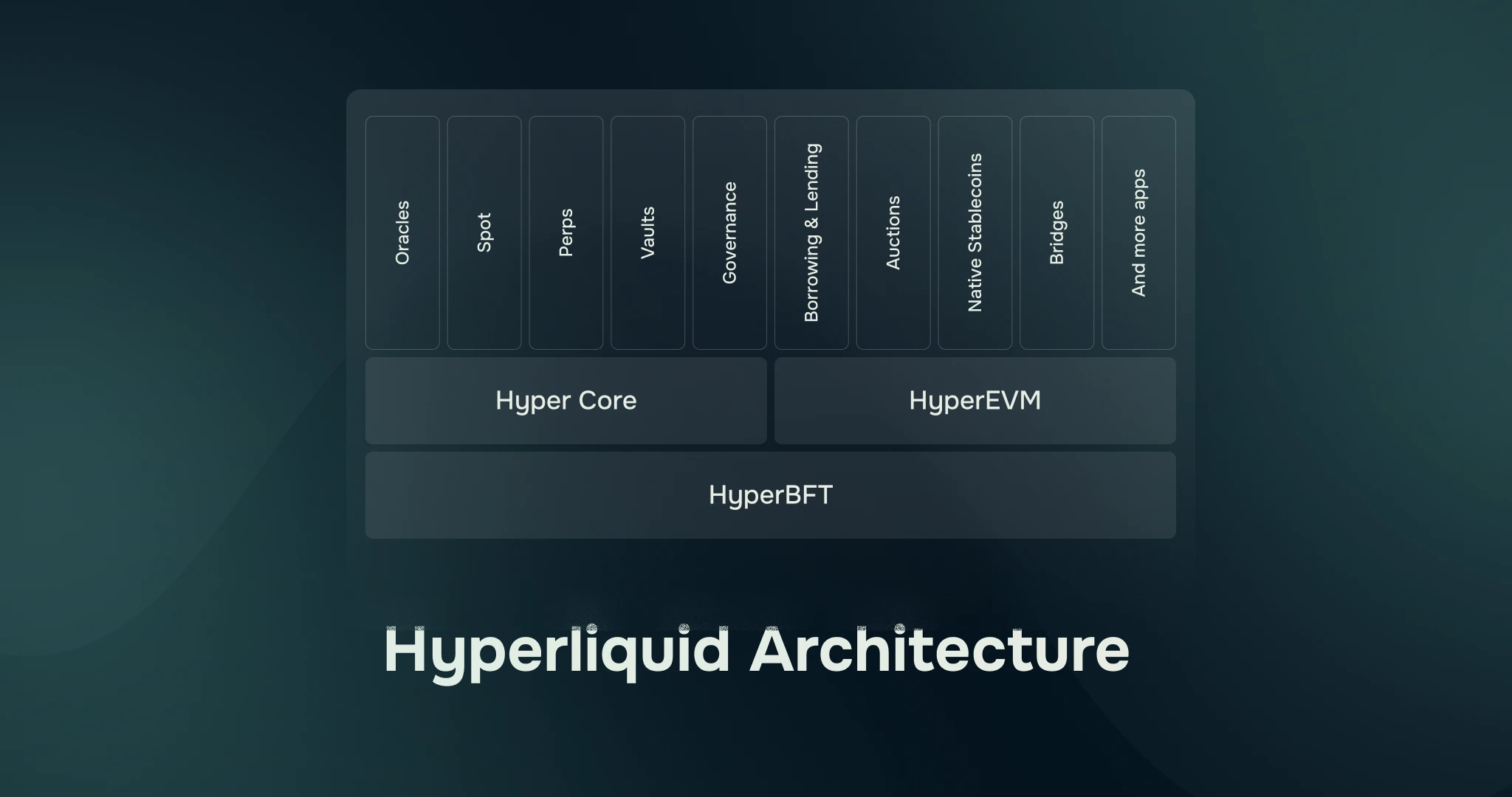
Hyperliquid doesn't run on Ethereum or any other existing blockchain. It is designed to run on a purpose-specific layer 1 optimized for order-book trading. This approach avoids congestion and gas fees that affect general-purpose chains during high-volume periods.
The chain was designed with trading as the primary use case. Every architectural decision, from block times to state management, was made to support fast, reliable order execution at scale.
HyperBFT Consensus
The blockchain uses HyperBFT, a consensus mechanism built for fast finality. Transactions confirm in milliseconds, which is essential for a trading platform where timing matters.
HyperBFT is a variant of Byzantine Fault Tolerant consensus optimized for the specific needs of a trading environment. It provides the security guarantees of traditional BFT systems while achieving the speed necessary for real-time order matching.
Fully Onchain Order Book
Most DeFi trading happens through AMMs, where liquidity pools and mathematical formulas determine prices. Hyperliquid takes a different approach with a traditional order book model.
With an order book, traders place specific buy and sell orders at exact prices. The matching engine pairs compatible orders directly. This gives traders more control over execution prices and typically results in lower slippage compared to AMM-based systems, especially for larger trades.
The entire order book operates onchain, meaning all orders and matches are recorded on the blockchain. This provides transparency and eliminates the trust requirements of off-chain order book systems.
Dual Execution Environment
Hyperliquid operates two distinct execution environments that work together:
- HyperCore handles the exchange's core trading functionality. This is where the order book, matching engine, and perpetuals logic live. It's optimized specifically for trading operations.
- HyperEVM is an EVM-compatible environment that supports general smart contract deployment. Developers can build applications using familiar Ethereum tooling while accessing the liquidity and infrastructure of Hyperliquid.
Hyperliquid Key Features
Deep Liquidity
Hyperliquid has attracted significant liquidity, with order book depth that competes with major centralized exchanges on popular pairs. Deep liquidity means large trades can execute with minimal price impact, which matters for serious traders.
The platform uses a market maker program and native incentives to maintain consistent liquidity across different market conditions.
Zero Gas Fees for Trading
Unlike most blockchain-based exchanges, Hyperliquid doesn't charge gas fees for placing or canceling orders. Traders only pay taker and maker fees when trades actually execute.
This model removes the friction of paying network fees for every interaction. You can place and cancel orders freely without worrying about transaction costs eating into your strategy.
High-Speed Performance
The combination of purpose-built infrastructure and HyperBFT consensus enables performance that matches centralized alternatives. Order placement and execution happen in milliseconds, with block times under one second.
This speed is critical for trading strategies that depend on timing. Market makers, arbitrageurs, and active traders can operate the same way they would on a CEX.
One-Click Trading
Hyperliquid offers a streamlined interface where trades can execute with a single click. Once you've deposited funds and set your preferences, you don't need to sign a transaction for each order.
This UX improvement removes the wallet pop-up friction that makes many DeFi platforms feel clunky compared to their centralized counterparts.
Self-Custody
Despite the CEX-like experience, Hyperliquid remains non-custodial. Your funds stay in your control through smart contracts. You can deposit and withdraw at any time without permission from the platform.
This gives traders the performance benefits of centralized exchanges while maintaining the security and autonomy of self-custody.
The HYPE Token
HYPE is the native token of the Hyperliquid ecosystem. It serves several functions across the platform:
- Gas on HyperEVM: Applications and transactions require HYPE for gas fees. This creates natural demand as the ecosystem grows.
- Staking: HYPE can be staked to participate in network security and earn rewards. Stakers help validate transactions and secure the network.
- Governance: Token holders can participate in protocol decisions as the governance system develops. This includes voting on upgrades and parameter changes.
- Fee capture: A portion of trading fees flows back to the protocol, creating value accrual for the token.
The token launched through one of the largest airdrops in DeFi history, distributing a significant portion to early platform users. This approach rewarded active traders and helped bootstrap a distributed holder base from day one.
What Makes Hyperliquid a Good Option for Developers and Users
Building on Hyperliquid offers several advantages to both developers and users:
For Developers
- Access to deep, unified liquidity: Applications can tap into the exchange's existing liquidity pools and order books without bootstrapping their own.
- HyperEVM compatibility: Developers can use familiar Ethereum tools, languages, and frameworks. Porting existing applications requires minimal changes.
- Optimized infrastructure: The underlying chain is built for performance, so applications benefit from fast finality and high throughput by default.
- Robust APIs and tooling: Comprehensive documentation, SDKs, and APIs make integration straightforward for both trading and general development.
For Users
- Low-latency trading: Sub-second execution means your orders fill at the prices you expect, even in volatile markets.
- Advanced trading tools: Limit orders, stop losses, take profits, and other order types that professional traders need.
- No gas fees and low-cost trading: Zero gas fees and competitive taker/maker fees keep trading costs minimal.
- Full onchain transparency: Every order and trade is recorded on the blockchain, providing verifiable execution.
Hyperliquid Ecosystem Projects

Hyperliquid has developed a growing ecosystem of projects building on the platform.
- DeFi protocols offering lending, borrowing, and yield strategies that integrate with Hyperliquid's liquidity.
- Trading tools and analytics platforms that provide advanced charting, portfolio tracking, and execution optimization.
- Infrastructure projects building bridges, oracles, and developer tooling for the ecosystem.
- NFT and social applications exploring what's possible when you combine EVM compatibility with high-performance infrastructure.
Conclusion
Hyperliquid represents a different approach to decentralized trading. By building a purpose-specific layer 1 with an onchain order book, the team has created a platform that delivers CEX-like performance without sacrificing self-custody or transparency.
The architecture solves real problems: fast execution, deep liquidity, and minimal fees. For traders frustrated with the limitations of AMM-based platforms, it offers a genuine alternative. For developers, the dual execution environment provides a foundation for building the next generation of DeFi applications.
Getting started on Hyperliquid requires bridging assets to the network. deBridge provides the fastest and most secure path, delivering native tokens without wrapped asset risk or slippage on the bridge itself.