How to Trade on Hyperliquid: A Step-by-Step Guide

Table of Contents
- Key Takeaways
- A Quick Overview of Hyperliquid
- Why Are Traders Choosing Hyperliquid
- Order Types on Hyperliquid
- How to Trade on Hyperliquid Step-by-Step
- Hyperliquid Trading Fees and Costs
- Risks and Considerations
- Conclusion
- Frequently Asked Questions (FAQs)
- Related Resources
Hyperliquid has quickly become one of the most talked-about decentralized perpetual exchanges in crypto. Built on its own Layer 1 blockchain, it delivers the speed and execution traders typically find only on centralized platforms. It features sub-second finality, zero gas fees on trades, a fully onchain order book, and full custody of user funds.
With millions in daily active users and trillions in notional volume through 2025, traders are choosing Hyperliquid for all the good reasons. But moving your assets to Hyperliquid from another chain can be challenging. This guide walks you through how to trade on Hyperliquid using deBridge, and explains why it stands out from other cross-chain options available today.
Key Takeaways
- Hyperliquid is a high-performance decentralized perpetuals exchange built on its own L1, offering sub-second finality and zero gas fees on trades.
- Before trading, you need to bridge assets to Hyperliquid from another chain using a cross-chain bridge like deBridge.
- The platform supports market, limit, stop, TWAP, and scale orders for traders at every level.
- Trading fees follow a maker-taker model, and there are no gas costs for placing or canceling orders.
- deBridge lets you move assets to Hyperliquid without wrapped tokens, pooled liquidity risks, or unnecessary delays.
A Quick Overview of Hyperliquid
Hyperliquid is a decentralized perpetual futures exchange built on its own custom layer 1 blockchain. It runs on HyperBFT, which provides the speed and throughput to process thousands of transactions per second with sub-second finality.
The platform is designed specifically for trading performance. This enables Hyperliquid to offer the trading experience previously available only on centralized exchanges while keeping everything verifiable onchain. You just need to connect your wallet, deposit funds, and trade directly from your own account without handing control to a third party.
Why Are Traders Choosing Hyperliquid
Hyperliquid has earned a strong position in the DeFi trading space by solving some of the biggest pain points that come with onchain perpetual trading. Let’s take a look at why traders are making the switch to Hyperliquid:
- Sub-second finality: Orders confirm within sub-seconds, removing the lag that hinders many decentralized exchanges.
- Advanced trading tools: A full set of order types gives traders the control they expect from a perps platform.
- Zero gas fees for trading: Traders only pay trading fees. There are no gas costs for placing or canceling orders.
- Non-custodial and secure: Users retain full control of their funds at all times, removing the counterparty risk that comes with centralized exchanges.
- Onchain order book: Every order lives on the blockchain, providing full transparency and verifiable execution.
Hyperliquid supports a broad range of order types to suit different trading styles and strategies. Understanding these before you start will help you execute more effectively and manage risk with greater precision.
Basic Order Types
- Market orders: Execute immediately at the best available price. Best for entering or exiting positions quickly.
- Limit orders: Set a specific price at which you want to buy or sell. The order only fills when the market reaches your target.
Advanced Order Types
- Stop market: Triggers a market order when the price hits a specified level. Commonly used as a stop-loss.
- Stop limit: Triggers a limit order instead of a market order, giving you more control over execution price after the stop fires.
- TWAP: Breaks a large trade into smaller trades executed over a set time period, reducing market impact.
- Scale orders: Spread your entry or exit across multiple price levels to improve your average fill in volatile conditions.
How to Trade on Hyperliquid Step-by-Step
Getting started involves two stages: bridging your assets to Hyperliquid's chain and depositing them into your trading account. Since Hyperliquid operates on its own L1, you cannot simply connect a wallet and start trading like you would on an Ethereum-based DEX. The sections below walk you through each step of the process.
Bridge Assets to Hyperliquid
You need to move assets to Hyperliquid's chain before placing any trades. deBridge is one of the fastest ways to do this because it transfers native tokens directly, avoiding the risks associated with pooled liquidity. Here is how to bridge using deBridge:
- Go to https://app.debridge.com
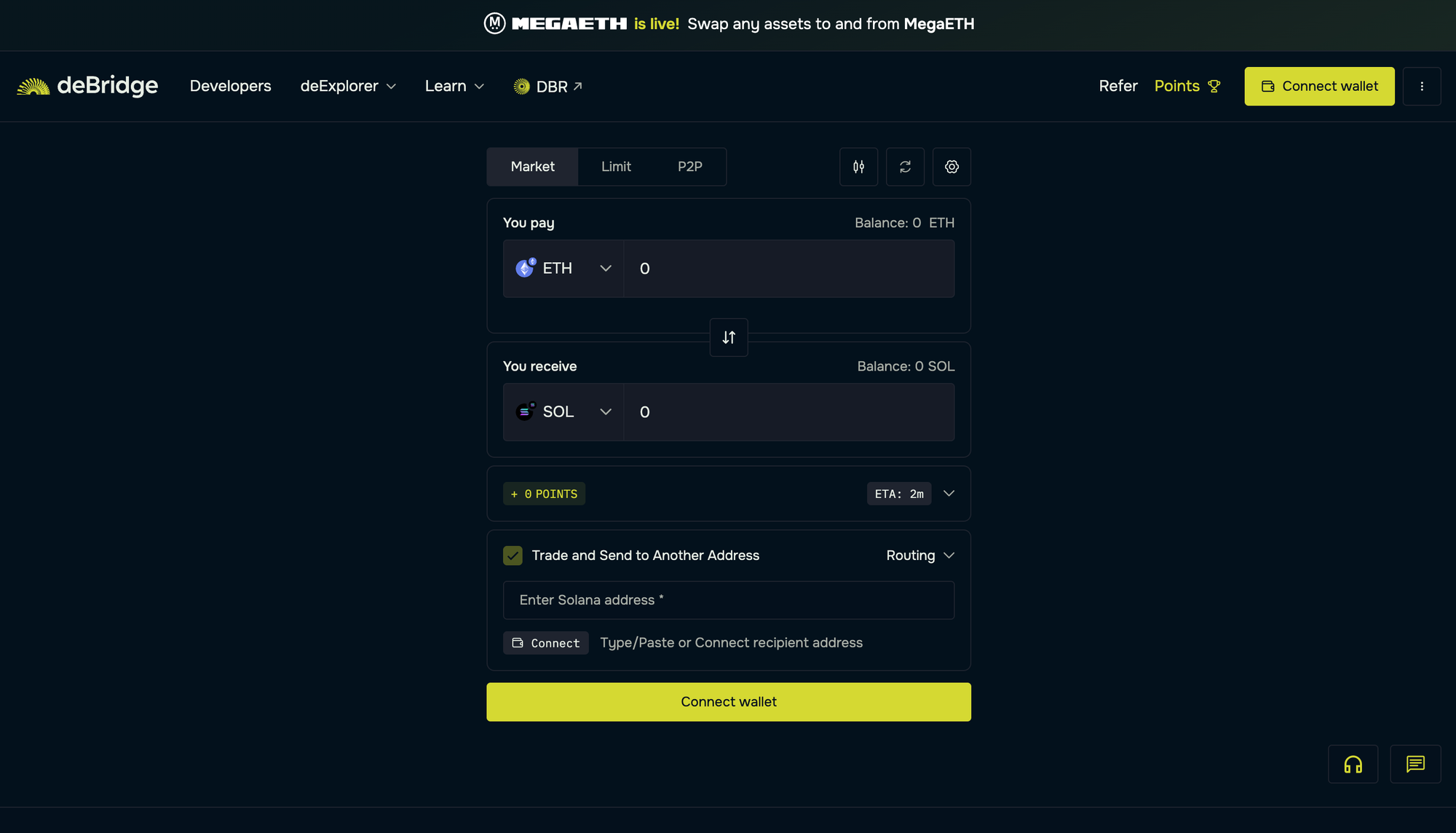
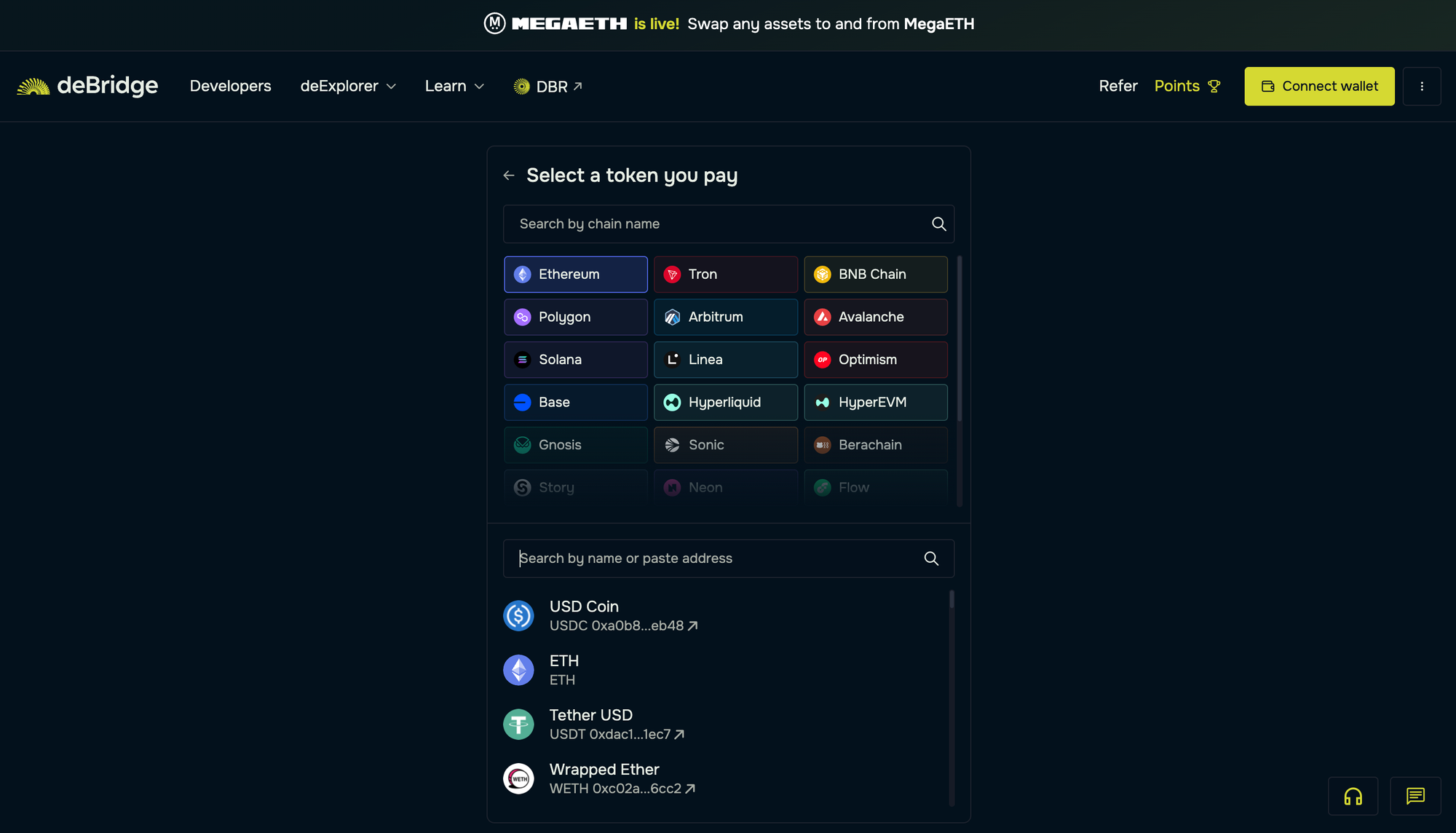
- Select your source chain (Ethereum) and asset (USDC)
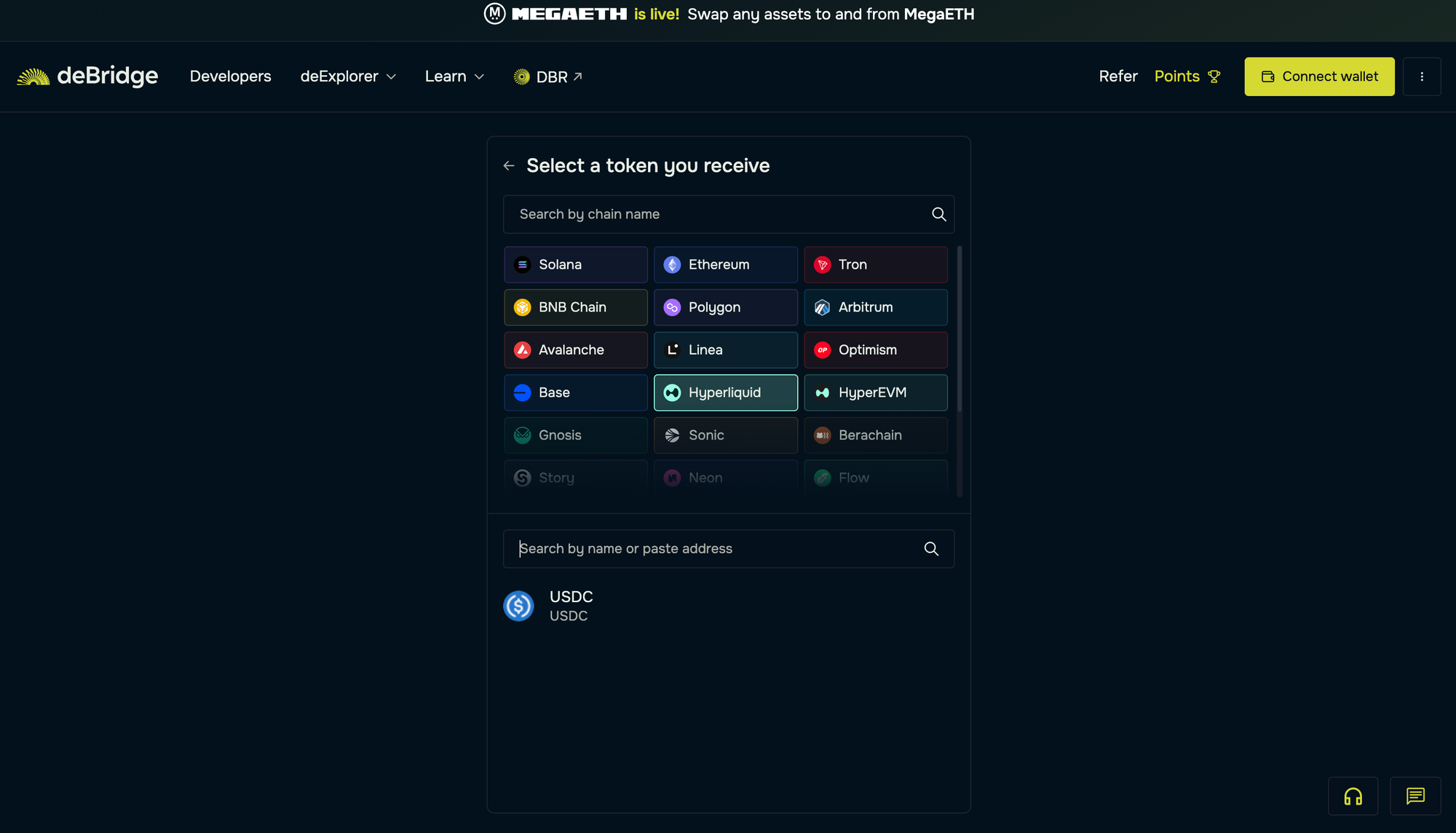
- Select Hyperliquid as the destination chain
- Connect your wallet (MetaMask, Phantom, or other supported wallets)
- Enter the amount of USDC you wish to bridge.
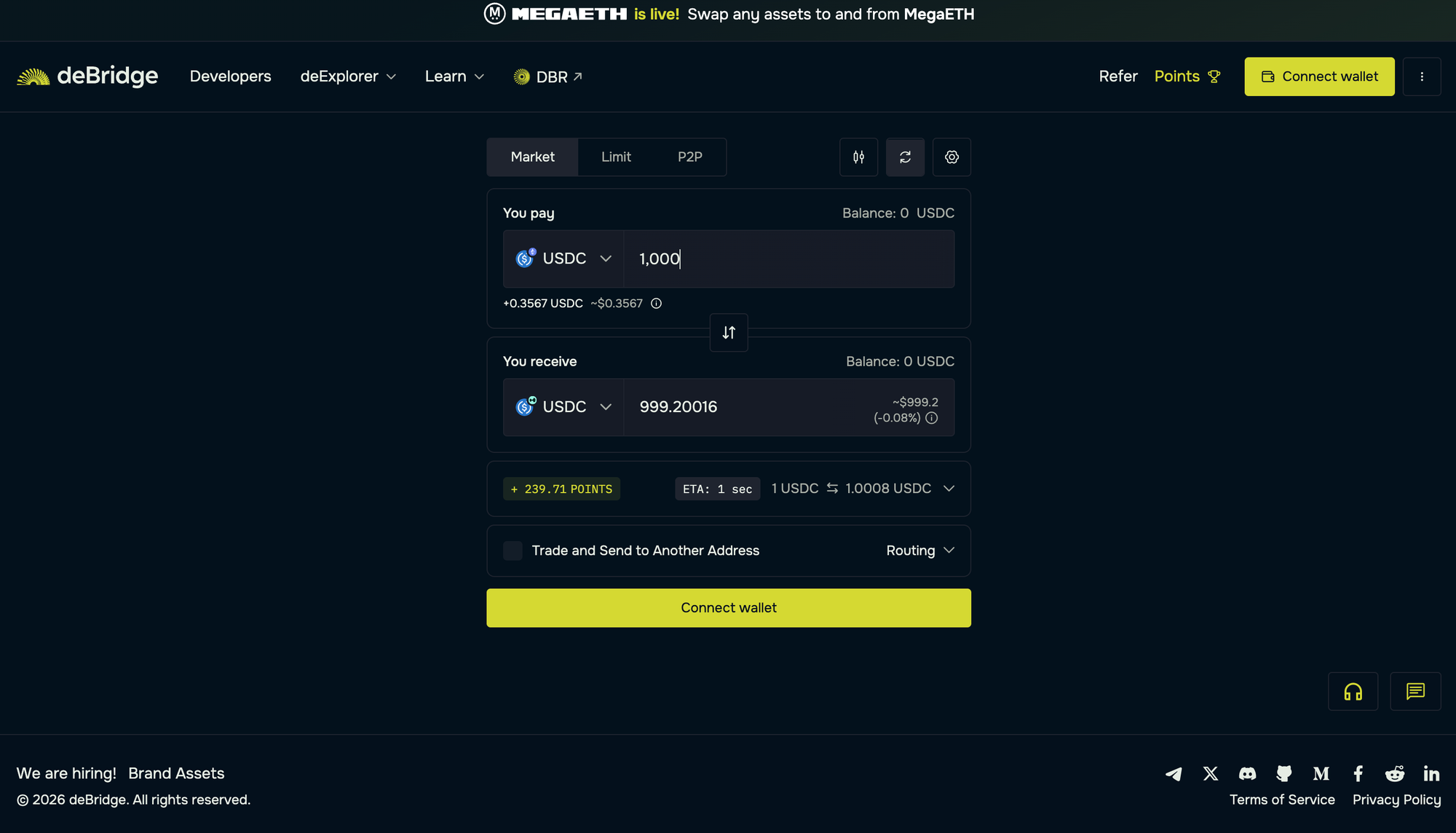
- Review the details and confirm the transaction in your wallet.
The bridging process is simple and only takes a few seconds to complete. You will receive the bridged assets in your Hyperliquid account.
Place Your Trade
With funds in your Hyperliquid account, you are ready to place orders. The UI is intuitive and similar to most centralized exchanges. Follow these steps for placing a trade on Hyperliquid:
- Select a trading pair: Choose a perpetual contract from the market selector (BTC-USDC, ETH-USDC, SOL-USDC, etc.).
- Choose the order type: Pick market, limit, stop, TWAP, or another order type based on your strategy.
- Set leverage and margin: Adjust leverage using the slider. Hyperliquid supports up to 40x on major pairs.
- Review and place the order: Check direction, size, price, and leverage, then confirm. No gas fee applies.
- Monitor your position: Track PnL, adjust leverage, or set stop-loss and take-profit from the positions panel.
Hyperliquid Trading Fees and Costs
Hyperliquid uses a maker-taker fee model with no gas fees for trading. Taker fees start at 0.0405%, and maker fees start at 0.0135%, with rates that can improve with trading volume and the amount of HYPE staked on its platform. For example, you receive a 10% discount for staking 100 HYPE on Hyperliquid.
Beyond trading fees, traders should also be aware of funding rates. Funding is a periodic payment between long and short positions that keeps perpetual contract prices aligned with the underlying spot price. Depending on market conditions and your position (long or short), you may pay or receive funding on a regular basis.
Risks and Considerations

While Hyperliquid offers strong performance and a transparent design, every trader should consider the potential risks before trading. Here are the key considerations before you start trading on the platform:
- Perpetual risk: Leveraged trading can amplify losses as much as it can amplify potential gains. Positions can be liquidated during sharp moves or when volatility spikes suddenly. Always use stop-loss orders and avoid overleveraging.
- Smart contract risk: Hyperliquid relies on smart contracts for matching and settlement. While audits are always possible, vulnerabilities remain in DeFi.
- Regional availability: Hyperliquid may not be accessible in all jurisdictions. Verify compliance with local regulations before trading.
- Withdrawal asset support: The platform supports a limited set of assets for deposits and withdrawals. Check token support before bridging to prevent loss of funds.
Conclusion
Hyperliquid stands out as one of the strongest options for decentralized perpetual trading, combining sub-second finality, zero gas fees, a fully onchain order book, and a non-custodial design.
Getting started begins with bridging your assets, and deBridge makes this fast and simple by transferring native tokens directly. Move assets from Ethereum, Solana, BNB Chain, Arbitrum, and 20 other networks to Hyperliquid in seconds.