How to Bridge from Ethereum to Solana Quickly and Securely

Table of Contents
- Key Takeaways
- Why Bridge ETH to Solana?
- Common Issues with ETH to SOL Bridges
- Step-by-Step Guide: How to Bridge ETH to Solana Using deBridge
- Reduce Gas Costs When Bridging ETH to Solana
- What Makes deBridge Unique for ETH to Solana Flows
- For Developers: Add ETH–Solana Bridging to Your App
- deBridge Security Summary
- Conclusion
- FAQs (Frequently Asked Questions)
- Related Resources
Bridging ETH to SOL enables faster transactions and significantly lower fees, while tapping into Solana’s growing DeFi, trading, and automation ecosystem. While Ethereum remains dominant in liquidity and DeFi, high gas costs and slower execution often prompt users to seek more efficient alternatives such as Solana.
However, ETH → SOL bridging is challenging due to differing token standards, reliance on wrapped assets, and liquidity pool risks that can lead to delays or security issues. deBridge solves this with native asset transfers, instant settlement, and a 0-TVL design, making it the fastest and safest way to bridge from ETH to Solana.
Key Takeaways
- Bridging ETH to Solana enables faster transactions and lower fees while providing access to Solana-native DeFi, NFTs, and trading tools.
- Most ETH→SOL bridges rely on wrapped tokens and liquidity pools, introducing security, slippage, and settlement risks.
- deBridge uses a 0-TVL architecture, eliminating pooled liquidity risk. Native asset transfers ensure immediate usability on Solana with no wrapped tokens.
- Real-time settlement in seconds makes deBridge the fastest and safest ETH–Solana bridge.
Why Bridge ETH to Solana?
Ethereum is the go-to network for OGs due to deep liquidity, established DeFi protocols, and trusted infrastructure. But its strengths also come with trade-offs, such as high gas fees and slower finality, especially during periods of heavy network traffic.
Solana flips that equation. With instant finality and low fees (typically under $0.01 per transaction), it’s built for performance and for those who don't like to wait. Solana is home to consumer-focused dApps, NFT platforms, and yield strategies that require speed and efficiency.
Common Use Cases
- NFT Minting: Participate in Solana-based NFT launches on platforms like Magic Eden and Tensor.
- Yield Aggregators: Put your assets to work on protocols such as Kamino or Jito.
- Arbitrage & Trading Bots: Execute strategies that require sub-second execution.
- DAO Participation: Vote and engage with Solana-native governance protocols.
Whether you're a yield farmer, NFT collector, builder, or DeFi power user, bridging ETH to Solana offers a gateway to faster, cheaper, and more popular blockchain use cases.
Common Issues with ETH to SOL Bridges
Most ETH-to-SOL bridges still rely on legacy mechanisms, such as liquidity pools, which can degrade the user experience. Wrapped tokens is another common issue, where ETH is locked, and a synthetic version is minted on the Solana side. The process creates trust assumptions, adds complexity, and opens the door to liquidity problems.
Common Bridging Pain Points
- Long Settlement Times: Many crypto bridges require multiple confirmations and oracle checks, leading to delays of over an hour.
- Centralized Bridges or Custodians: Some bridges rely on third-party custody, creating a single point of failure and contradicting DeFi’s decentralization ethos.
- Failed or Stuck Transactions: Poorly maintained interfaces, buggy smart contracts, and overloaded validators can cause transactions to become stuck or fail to complete.
- Slippage on large volumes: Liquidity pool-based bridges suffer from high slippage, particularly during periods of high volatility or large transfers.
These challenges can erode user trust and hinder cross-chain movement, highlighting that traditional bridges aren’t designed for scale or a great user experience.
How deBridge Solves It
deBridge removes the bottlenecks and risks of liquidity pools by enabling value and information to flow instantly across the DeFiverse with deep liquidity and guaranteed rates.
- Native asset bridging means no wrapped tokens.
- 0-TVL architecture helps eliminate pooled liquidity risk.
- Instant finality ensures funds arrive in your wallet immediately.
- Multi-wallet support lets you use any wallet, including MetaMask, Phantom, Coinbase Wallet, and more.
Learn how deBridge improves DeFi UX with real-time bridging.
Step-by-Step Guide: How to Bridge ETH to Solana Using deBridge
deBridge provides an instant bridging solution to help you bridge assets between Ethereum and any asset on the Solana network and vice versa. Let's explore how to perform cross-chain bridging for your crypto assets in a few simple steps.
- Go to app.debridge.com
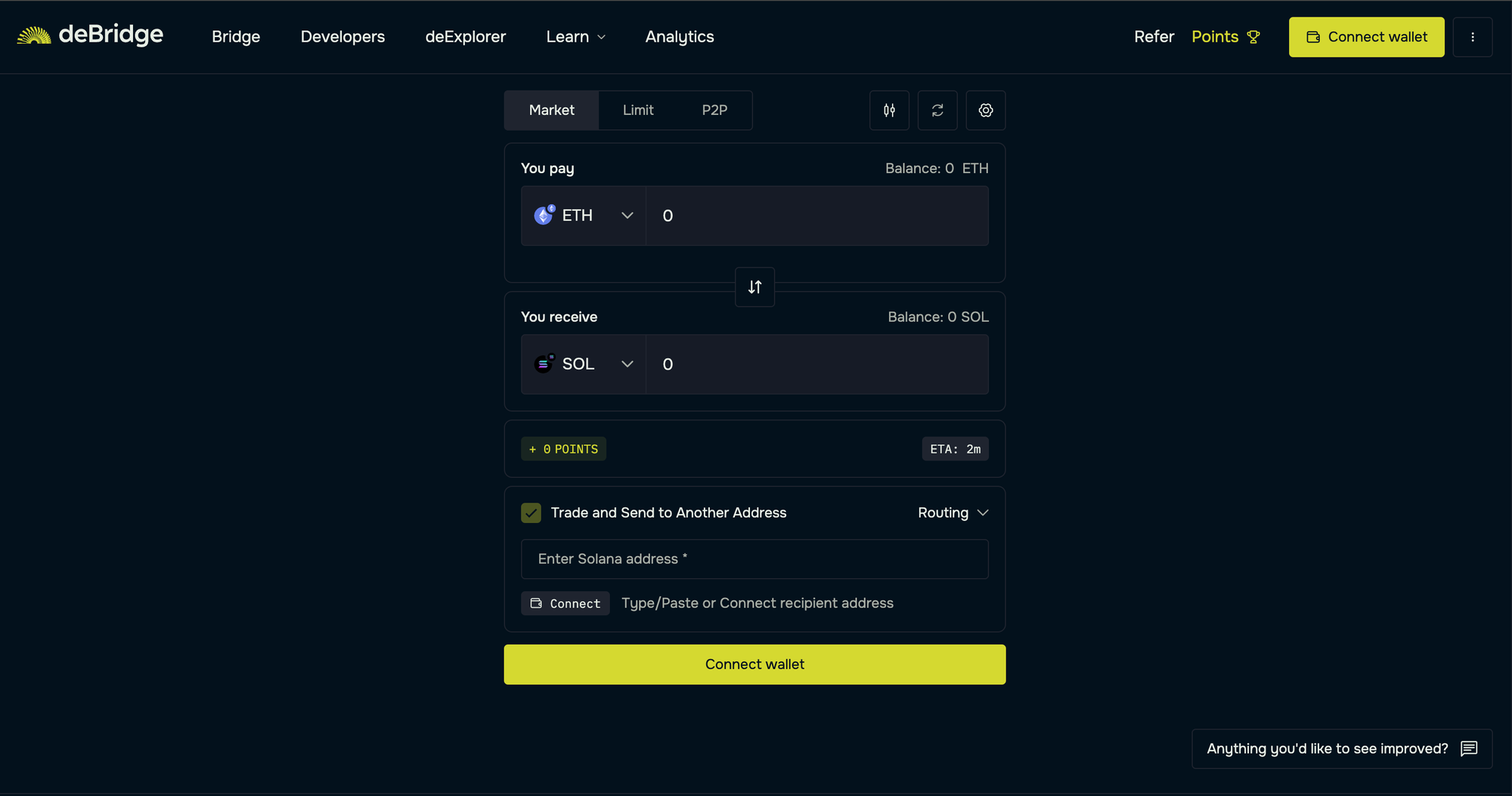
- Connect your Ethereum wallet address as the source and your Solana wallet address as the destination.
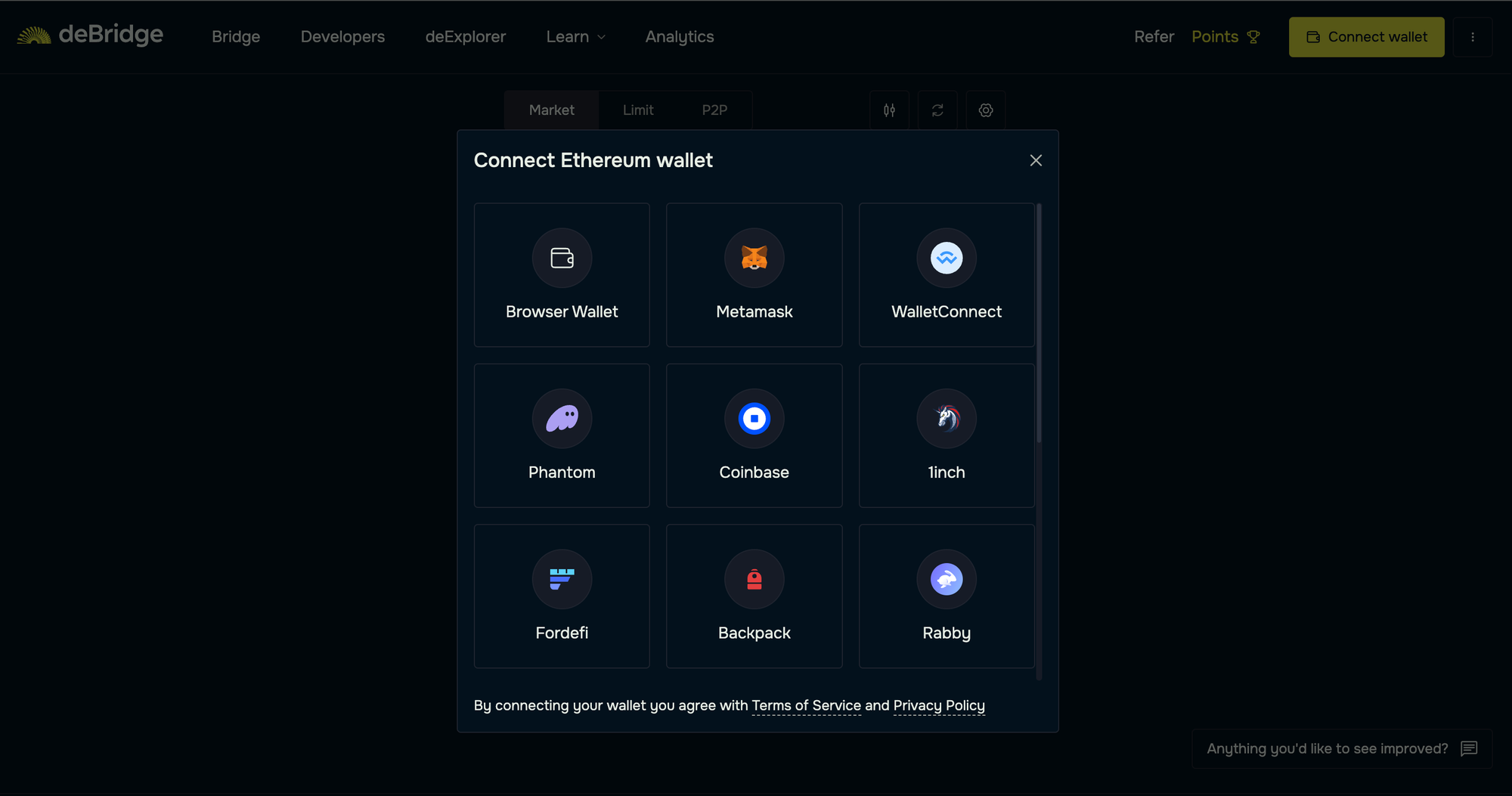
- Select the source chain (Ethereum) and asset you want to bridge. Here, we will bridge ETH to SOL.
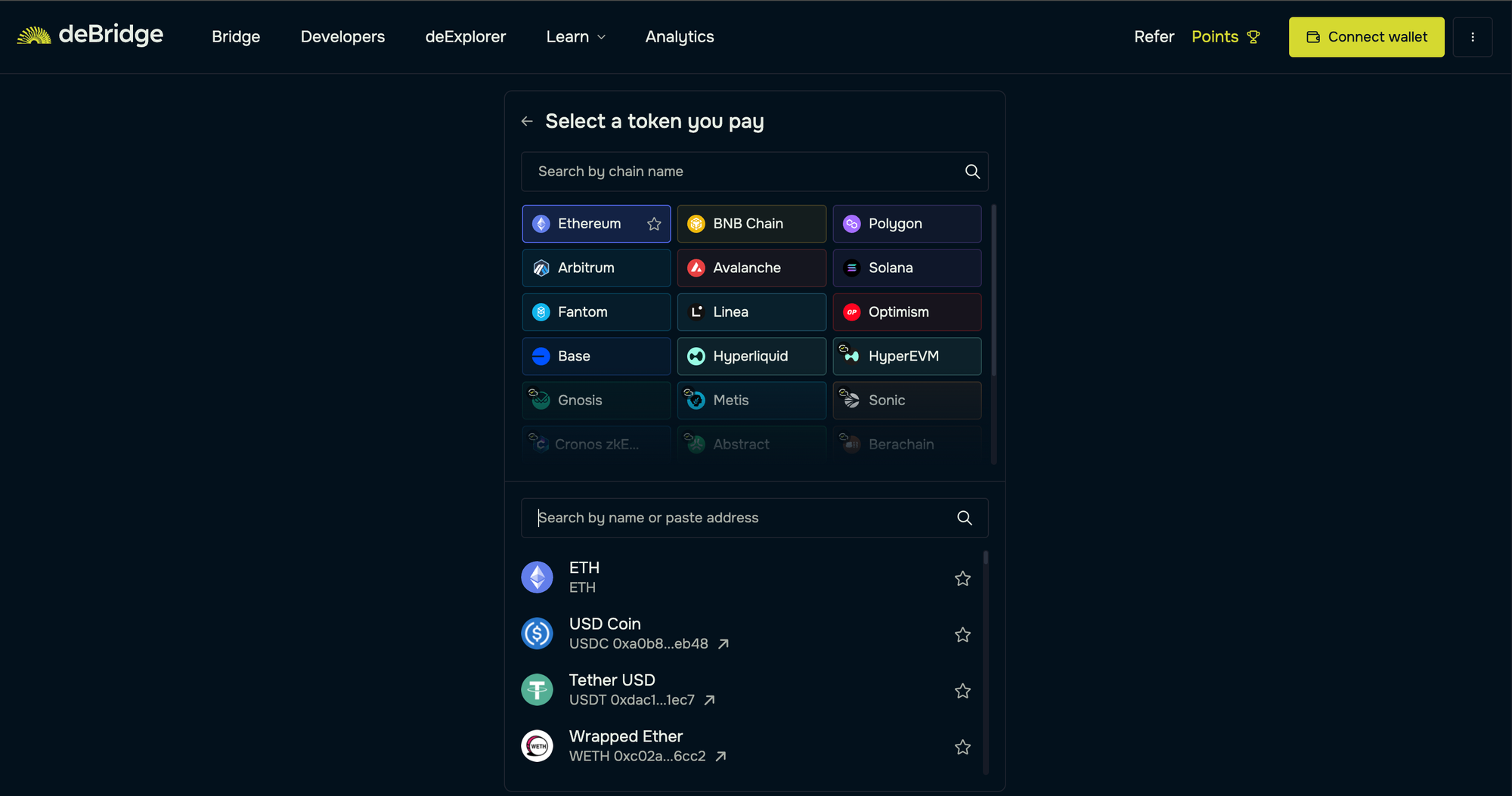
- Next, select Solana as the destination chain and the token you want to receive. Here, we will select SOL as the asset on the target chain.
- Enter the quantity in ETH and review the transaction details.
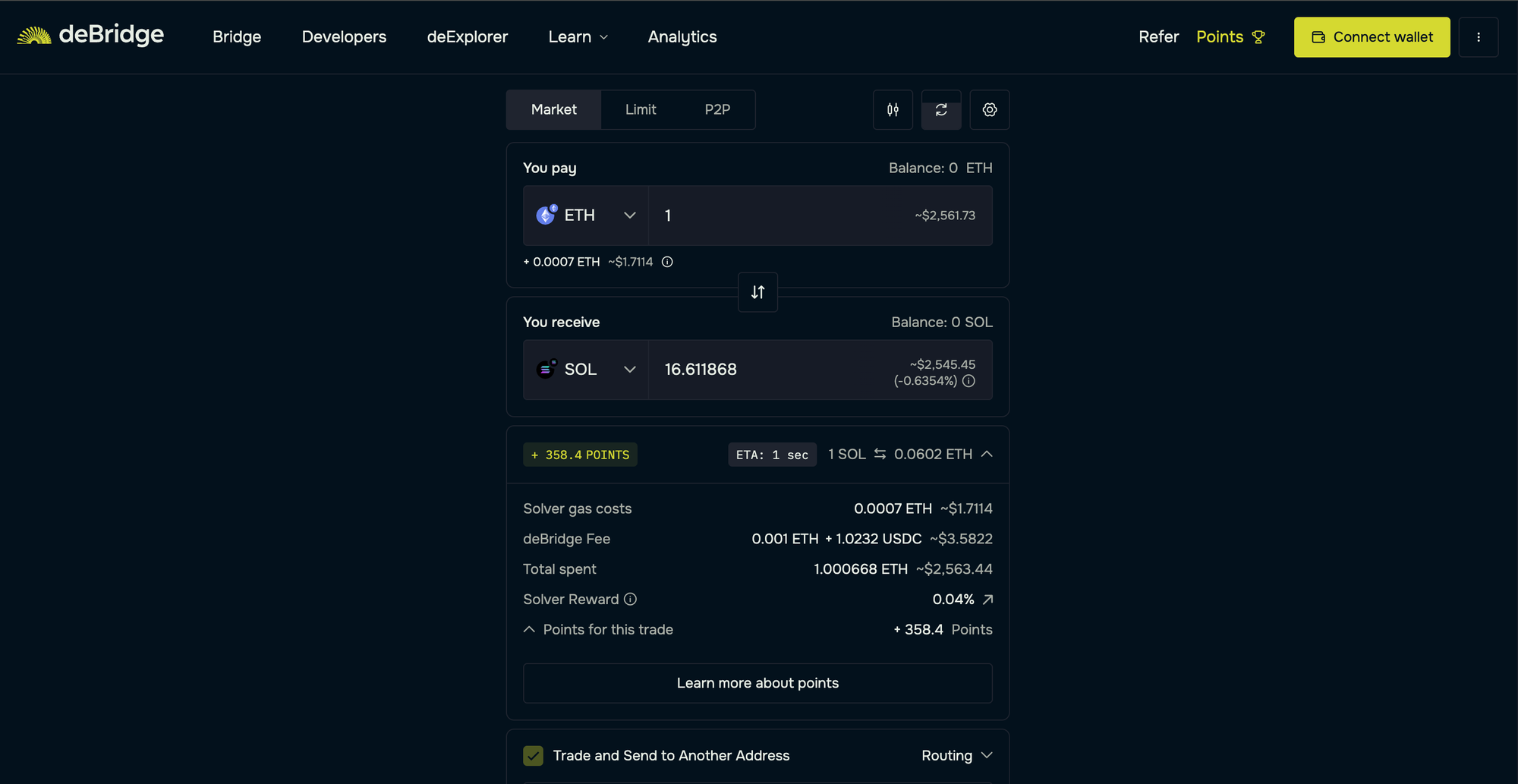
- As the final step, confirm the trade, pay gas fees in ETH, and sign the ensuing transactions to receive crypto in your Solana wallet.
The bridging process takes 1-2 seconds, and you'll see the "Order Fulfilled" pop-up, which indicates that the bridged assets (SOL) have been received in your Solana wallet.
Pro Tips
- Make sure your destination wallet is already set up to receive SOL
- For best results, avoid bridging during high Ethereum gas congestion
Technical users can also inspect the transaction(s) on the Solana mainnet explorer.
Reduce Gas Costs When Bridging ETH to Solana
Gas fees on Ethereum are a major issue, particularly during periods of high network congestion. While deBridge is optimized for fast, cost-effective bridging, users can take additional steps to reduce gas costs further. Let’s read about them:
Optimization Tips
- Monitor Ethereum gas prices: Use Etherscan to see current network conditions and track gas prices.
- Avoid peak congestion times: Gas fees are higher during weekday afternoons (UTC). Consider initiating your bridge during off-peak hours, such as late at night UTC or on weekends.
- Use "average" or "custom" settings: Most wallets let you choose among "slow," "average," and "fast" gas speeds. Opting for "average" offers a good balance between speed and cost.
While gas efficiency not only saves you money, it also reduces network load and supports a more sustainable ecosystem. By staying on top of the gas prices, users can make ETH→SOL bridging even more affordable.
What Makes deBridge Unique for ETH to Solana Flows
deBridge differentiates itself with a 0-TVL architecture that eliminates pooled-liquidity risk common in traditional bridges. It enables native asset transfers (no wrapped tokens) with near-instant settlement in 1–2 seconds.
Built for both users and developers, deBridge supports major wallets and offers easy SDK and API integration for scalable cross-chain applications.
Comparison Table
For Developers: Add ETH–Solana Bridging to Your App
deBridge is DeFi’s internet of liquidity, enabling real-time movement of assets and information across the DeFi landscape. For builders, deBridge offers a seamless way to integrate cross-chain transfers directly into their dApp, decentralized exchange, or wallet.
With our API and embeddable bridge widget, you can enable users to move assets across supported networks, including Ethereum, Binance Smart Chain, Arbitrum, Solana, and more, in seconds. Developers building in the crypto space are welcome to integrate deBridge for seamless cross-chain interactions within their dApp.
Now, with an added functionality, you can explore how to fetch real-time DeFi data with deBridge Hooks.
Why Integrate deBridge?
If you're building a dApp, wallet, or DeFi protocol that requires cross-chain connectivity, integrating deBridge is an easy way to onboard Ethereum users to the Solana ecosystem.
- Multi-chain SDK: Supports EVM and Solana out of the box
- Plug-and-play APIs: Simplify integration and speed up time to market
- Real-time execution: Assets arrive in seconds
- Affiliate routing: Earn revenue from each transaction routed through your app
deBridge is designed for performance, making it ideal for both startups and larger dApps to integrate the deBridge widget or API.
deBridge Security Summary
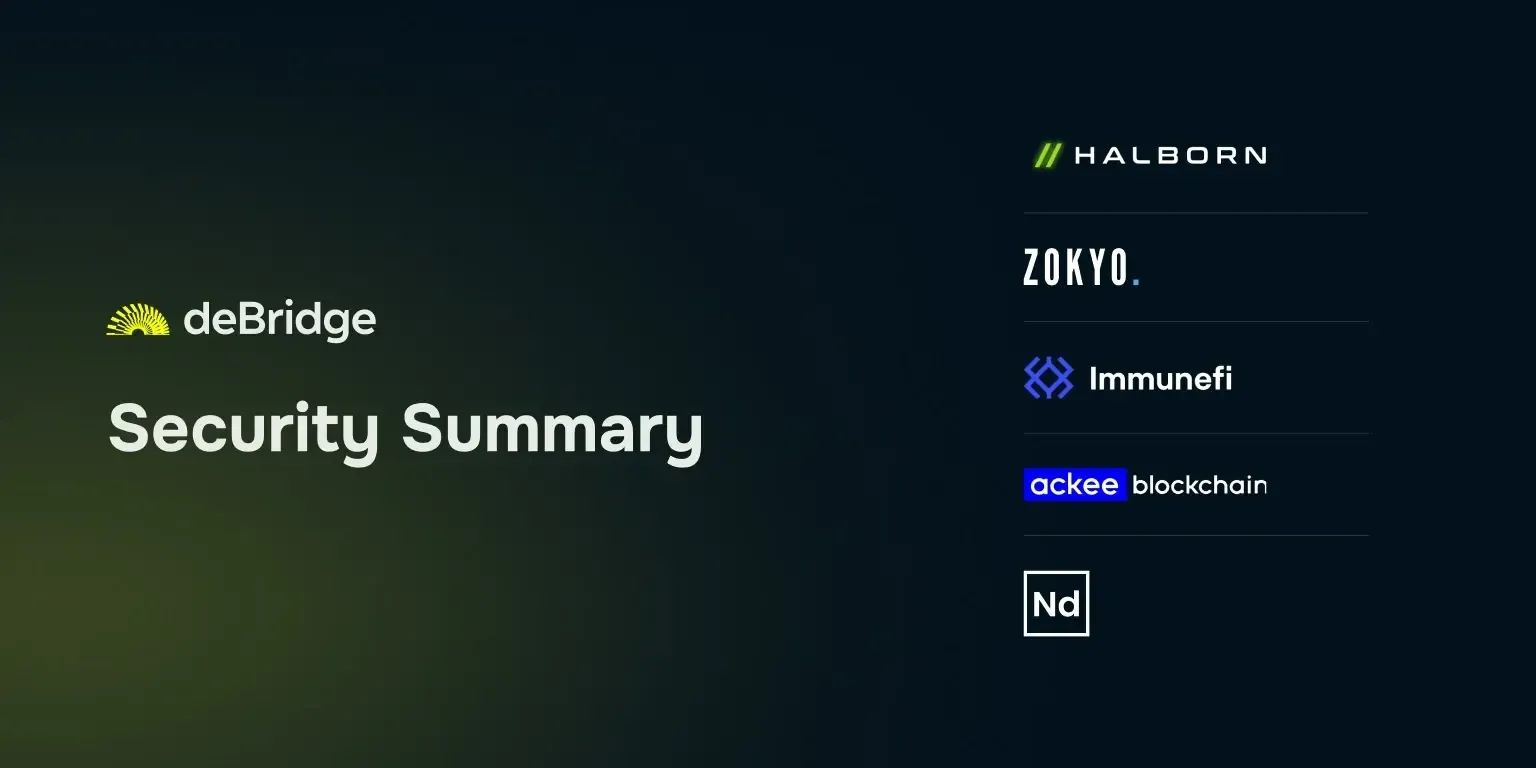
Security is a top priority for bridging, and deBridge is designed with that focus.
Unlike traditional crypto bridges that pool user funds into smart contracts or liquidity pools, deBridge uses a 0-TVL architecture that bypasses liquidity pools. This ensures there is no attack surface for exploits such as pool draining or front-running.
Today, it’s trusted by major ecosystem players, including Phantom, MetaMask, Trust Wallet, Jupiter Exchange, and more. deBridge gives you the confidence needed to move assets across 25+ chains in seconds.
Why Users Trust deBridge?
deBridge has been trusted by users of all generations for bridging to anywhere in DeFi. It also includes several features, such as:
- 0-TVL = no pooled liquidity risk
- Audited 30+ times, zero security incidents
- Funds delivered before finalization
- Trusted by Phantom, Jupiter, and Solflare
Conclusion
Bridging from Ethereum to Solana unlocks faster execution, low fees, and access to high-performance DeFi and trading use cases that aren’t feasible on Ethereum alone. However, traditional ETH→SOL bridges often introduce risks through wrapped tokens, liquidity pools, and slow settlement.
deBridge stands out as the optimal solution, offering real-time settlement, native asset transfers, and a 0-TVL architecture; delivering the fastest, safest, and most seamless way to move value from Ethereum to Solana.