Best Tron Swap DEXs for Fast and Secure Swaps in 2026

Table of Contents
- Key Takeaways
- How Tron Swap DEXs Work
- 5 Best Tron Swap DEXs
- How to Choose the Best Tron Swap DEX
- deBridge for Cross-Chain Swaps
- Frequently Asked Questions (FAQs)
- Related Resources
Developed in 2017, Tron is one of the fastest-growing and most active blockchains in the market. It is home to the largest circulating supply of USDT and is known for processing transactions at high speed with low fees.
Tron is the preferred network for millions of users when it comes to stablecoin transfers, trading, and everyday DeFi activity. As the ecosystem has matured, so has the number of ways users can swap assets on Tron. Today, Tron swap DEXs fall into two clear categories: Onchain swap DEXs (standard AMMs) and Cross-chain swap protocols.
In this guide, we break down how Tron swap DEXs work, compare the best Tron swap platforms in 2026, and explain why modern cross-chain protocols like deBridge are the first choice for fast, secure, and native swaps.
Key Takeaways
- Tron is known for its high-speed transactions, low fees, and its role as the home of the largest USDT supply.
- There are two types of Tron Swap DEXs: standard AMM DEXs for onchain swaps and Cross-Chain swap protocols for cross-chain swaps.
- Not all DEXs work the same way; some have limited wallet or token support and rely on liquidity pools.
- deBridge offers both onchain and cross-chain swaps with real-time execution, zero slippage, low, transparent fees, and no liquidity pool risk.
How Tron Swap DEXs Work
Before selecting a platform, it’s important to understand how Tron swap DEXs work beyond the surface. While they look similar at first glance, their underlying execution models vary greatly.
Standard AMM Swap DEXs
AMM (Automated Market Maker) DEXs are the most common type of decentralized exchange on Tron. These platforms rely on liquidity pools, where users deposit token pairs that traders swap against. Prices are determined algorithmically based on pool ratios rather than order books.
AMM Swap DEXs provide deep liquidity for popular Tron-native tokens, offer a simplified UI, and integrate well with Tron wallets. However, they also have drawbacks, including high slippage on large trades, impermanent loss, and limitations on onchain swaps. They are best suited for small to medium-sized onchain swaps within the Tron ecosystem.
Cross-Chain Swap Protocols
Cross-chain swap protocols enable users to swap assets across blockchains, such as moving USDT from Ethereum to Tron. These allow access to Tron from other ecosystems, helping expand capital mobility across multiple blockchains. There are two main cross-chain models:
- Cross-chain AMMs (pool-based): These rely on liquidity pools deployed across multiple chains. A popular example is Symbiosis.
- 0-TVL cross-chain protocols: These do not rely on pooled liquidity. Instead, they execute swaps using external liquidity sources and message-passing infrastructure. deBridge is a popular example.
Some users also rely on DEX aggregators, which do not hold liquidity themselves but route trades across multiple underlying DEXs and protocols to find the best price.
5 Best Tron Swap DEXs
Although numerous options are available, we have narrowed the list to 5 Tron Swap DEXs that cover both onchain and cross-chain use cases.
- deBridge
- SunSwap
- Symbiosis
- JustSwap
- Relay
deBridge
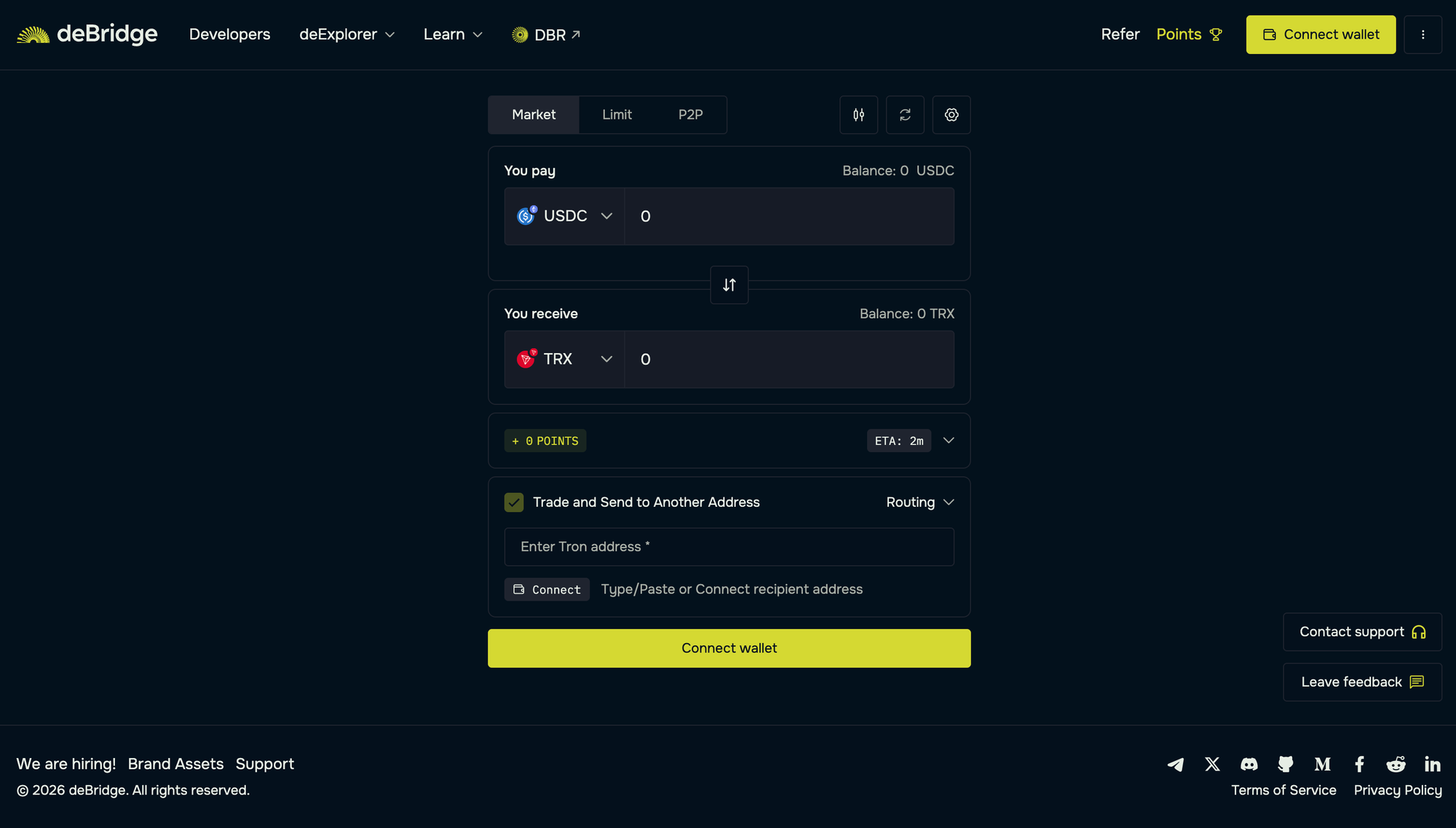
deBridge is a cross-chain infrastructure that supports transfers to Tron through its 0-TVL model, meaning no pooled liquidity and no wrapped tokens. It routes transactions in real time across chains, including Ethereum, BNB Chain, Solana, Base, and 21 others.
Supported tokens: Millions (ETH, USDC, TRX, USDT, SOL, ARB, DOGE, BNB, HYPE, etc.)
Supported wallets: Tron (Tron Link, Trust Wallet, and Tron WalletConnect)
Supported chains: Ethereum, Solana, Base, HyperEVM, and 21 more.
Developer tools: SDK, APIs, cross-chain widgets, deBridge Hooks for automation
Why choose deBridge?
deBridge has processed over $17 billion in transactions and is trusted by well-known wallets and dApps like Phantom, Trust Wallet, Jupiter Exchange, and many others.
- Native asset transfers (no wrapped token risks)
- Real-time execution with instant finality
- Zero slippage (always receive the exact amount)
- Deep security track record with 30+ audits
- $200k bug bounty program
- Developer-friendly APIs
SunSwap
SunSwap is the leading AMM-based DEX native to Tron and part of the SUN ecosystem. It provides deep liquidity for TRX-based pairs and stablecoins like USDT and USDC.
Supported tokens: 100+ Tron-native assets, including TRX, USDT, SUN
Supported wallets: TronLink, Trust Wallet, and more
Developer tools: Limited AMM integrations
Why Choose SunSwap?
SunSwap offers strong liquidity and deep integration with Tron’s ecosystem. However, it relies entirely on liquidity pools, which means slippage and pool risks increase for large trades.
Symbiosis
Symbiosis is a cross-chain AMM protocol that supports swaps between Tron and other networks through liquidity pools deployed across chains.
Supported tokens: Thousands across multiple chains
Supported wallets: Tron Link, Trust Wallet, Bitget Wallet, and more
Developer tools: Cross-chain routing APIs
Why Choose Symbiosis?
Symbiosis offers broad chain coverage, but its pool-based design introduces liquidity fragmentation and potential slippage, particularly during volatile market conditions.
JustSwap
JustSwap was one of Tron’s earliest decentralized exchanges and helped bootstrap onchain liquidity during the network’s early growth phase.
Supported tokens: 50+ Tron-based assets
Supported wallets: TronLink
Developer tools: Minimal
Why Choose JustSwap?
JustSwap remains functional and simple, but its liquidity and tooling are limited compared to newer DEXs. It is best suited for small, straightforward swaps rather than advanced trading.
Relay
Relay is a cross-chain protocol for asset movement across chains, including Tron. It focuses on message passing and transaction relaying, enabling users to move assets and execute actions across networks.
Supported tokens: Thousands, including USDT, USDC, and ETH (varies by route)
Supported wallets: MetaMask, WalletConnect-compatible wallets, and more
Developer tools: Cross-chain messaging and relay APIs
Why Choose Relay?
Relay Protocol stands out for its lightweight cross-chain execution model and focus on interoperability. However, because it relies on external liquidity and relayers, fees and execution certainty can vary, especially during periods of high network congestion.
How to Choose the Best Tron Swap DEX
Choosing the right Tron swap DEX depends on how and where you want to trade. Not all platforms offer the same execution model, risk profile, or asset coverage. Here are some points worth considering when choosing a Tron swap DEX:
- Swap type: Onchain swaps vs cross-chain swaps
- Liquidity & slippage: Pool-based AMMs vs slippage-free execution
- Fees: Transparent, predictable costs
- Wallet support: Tron-native, Solana, and EVM compatibility
- Security model: Liquidity pools vs non-custodial designs
For simple onchain swaps, SunSwap might work out fine for you. But if you are looking for a protocol that delivers both onchain efficiency and cross-chain reliability, deBridge stands out, offering real-time execution, no pooled-liquidity risk, and a unified solution across chains.
deBridge For Cross-Chain Swaps
For users moving assets into or out of Tron, deBridge is the best solution in 2026. Its real-time execution, slippage-free swaps, and no-pooled-liquidity-risk architecture make it uniquely suited for high-value, time-sensitive transactions.
By removing liquidity pools entirely, deBridge eliminates many of the risks inherent in traditional bridges and AMMs, while delivering native assets directly on Tron.