Best Polygon Bridges for Fast Cross-Chain Transfers in 2026

Table of Contents
- Key Takeaways
- How Polygon bridges work
- Best 7 Polygon Bridges
- How to choose the best Polygon bridge
- Why deBridge is the best option
- Frequently Asked Questions (FAQs)
- Related Resources
Polygon has become a go-to network for DeFi users, traders, and NFT buffs seeking to avoid Ethereum's high gas fees. Whether you're yield farming, trading tokens, collecting NFTs, or playing blockchain games, moving assets to and from Polygon is something you'll do frequently.
The challenge? Many cross-chain bridges cause delays, slippage, or require you to use wrapped tokens. Poorly designed bridges have already been targeted by hackers, resulting in billions of dollars in damage.
This article explores the best Polygon bridges in 2026 that offer fast execution, native asset support, and a smooth user experience.
Key Takeaways
- Bridging to Polygon gives users access to faster, cheaper DeFi and broader ecosystems.
- All listed bridges support major wallets, including MetaMask, Trust Wallet, and Coinbase Wallet.
- deBridge stands out for real-time native transfers, no slippage, zero pooled-liquidity risk, and enterprise-grade security.
- For developers, robust APIs and SDKs make integration significantly easier.
How Polygon Bridges Work
Bridging moves tokens between blockchains using smart contracts, liquidity pools, or validators, with trade-offs in speed, cost, and slippage. Whether you're bridging from Ethereum, Base, Arbitrum, or any other chain to Polygon, understanding these models helps you choose wisely.
Lock-and-Mint Model
Locks original tokens on the source chain, mints wrapped versions on the destination. Bridging back burns wrapped tokens and unlocks originals.
Pros: Straightforward, works across token standards, lower costs
Cons: Wrapped tokens, custody risk, additional bridging fees
Liquidity Pool Model
Maintains token reserves on both chains. You swap from one pool and receive from the destination pool.
Pros: Faster, can support native assets
Cons: Slippage during imbalances, requires liquidity, pools are exploit targets
0-TVL Model
Validators and solvers source liquidity externally, fulfilling orders in real-time before onchain settlement.
Pros: No slippage, minimal custody risk, native assets, fast
Cons: Relies on validators for all transactions
ZK/Rollup Model
Uses cryptographic proofs to verify transactions and bundles transfers with validity proofs.
Pros: Cryptographic security, lower bundled costs, trustless
Cons: Slower finality, limited chain pairs, and often wrapped tokens
Best 7 Polygon Bridges
There’s no one-size-fits-all bridge when it comes to moving assets to or from Polygon. We’ll analyze the 7 best Polygon bridges, highlighting how each works, which chains it supports, and why it stands out for speed, safety, or ease of use, helping you choose the right one.
- deBridge
- Across
- Synapse Protocol
- Wormhole
- Celer cBridge
- Polygon PoS Bridge
- Polygon zkEVM Bridge
deBridge
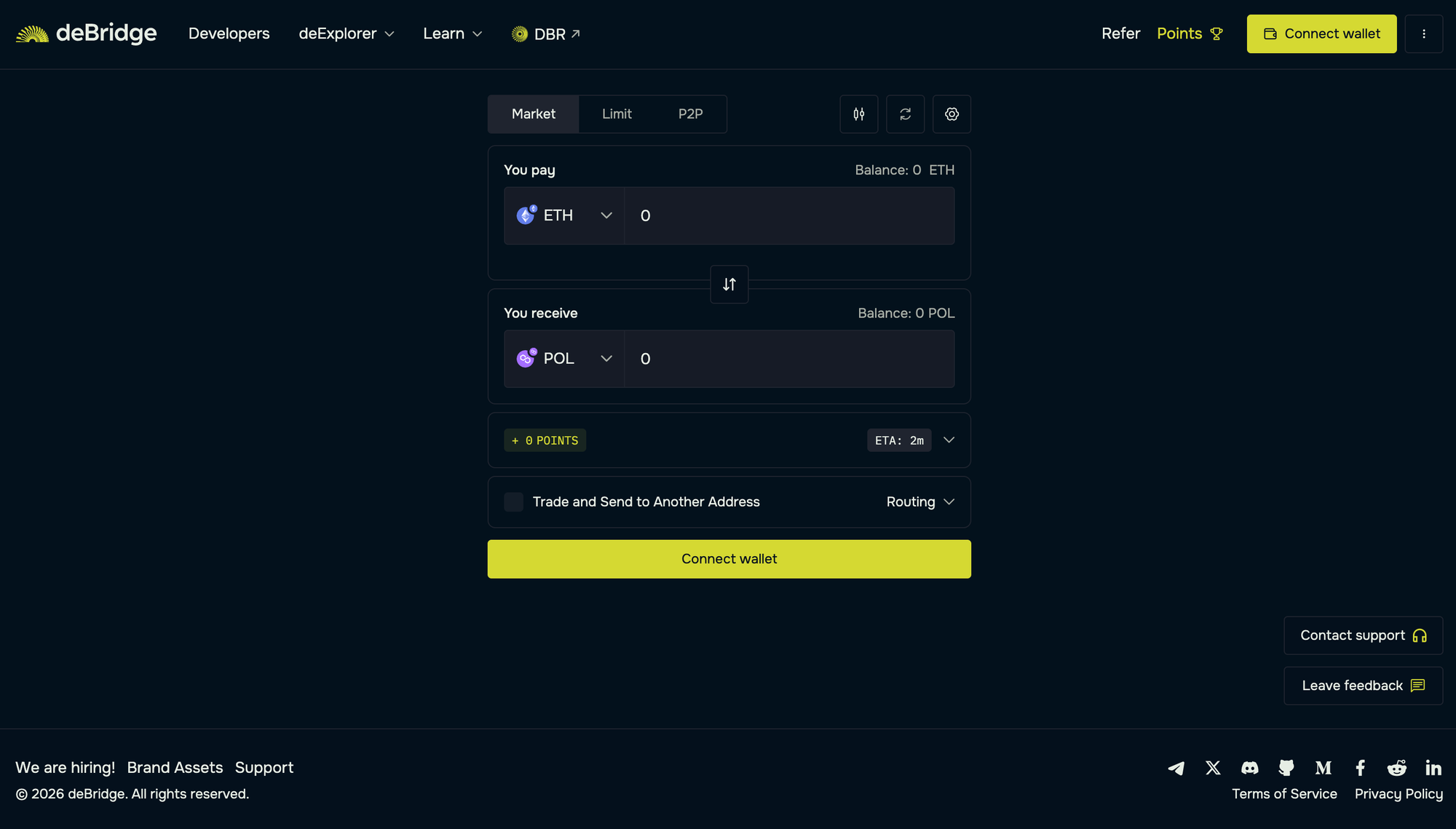
deBridge enables fast, secure transfers across 25+ blockchains using a 0-TVL architecture where validators source liquidity externally.
- Supported tokens: Millions of tokens, including USDC, USDT, ETH, POL, SOL
- Supported wallets: MetaMask, WalletConnect, Coinbase Wallet, Trust Wallet, Phantom, and more
- Developer tools: SDK, API, and embeddable widget
- Best for: Fast, slippage-free large transfers with native assets
Why Choose deBridge?
deBridge delivers native assets instantly (seconds) without wrapped tokens. The 0-TVL model eliminates custody risk and slippage. Security includes 30+ audits and zero exploits with decentralized validators.
Across
Across uses an optimistic model with liquidity pools for fast EVM transfers.
- Supported tokens: Thousands, including ETH, USDC, USDT, WBTC, DAI
- Supported wallets: MetaMask, WalletConnect, Coinbase Wallet, and more
- Developer tools: API and SDK
Why Choose Across?
Across delivers fast transfers (within minutes) by having liquidity providers front assets. However, pools can experience slippage during high-volume periods, creating security risks.
Synapse Protocol
Synapse connects Polygon to 20+ blockchains using liquidity pools and cross-chain messaging.
- Supported tokens: 100+, strong stablecoin support
- Supported wallets: MetaMask, WalletConnect, Coinbase Wallet, Trust Wallet
- Developer tools: Cross-chain messaging SDK
Why Choose Synapse Protocol?
Synapse offers broad chain coverage for networks others don't support, with deep stablecoin liquidity. However, expect potential slippage when pools are imbalanced.
Wormhole
Wormhole enables transfers between Polygon and 30+ blockchains using lock-and-mint. Its bridge interface is branded as Portal.
- Supported tokens: 200+ across ecosystems
- Supported wallets: MetaMask, Phantom, Coinbase Wallet, WalletConnect
- Developer tools: Comprehensive SDK and APIs
Why Choose Wormhole?
Wormhole's strength is broad ecosystem coverage. However, you receive wrapped tokens (whETH, whSOL), limiting DeFi composability.
Celer cBridge
Celer cBridge connects Polygon to 40+ blockchains using liquidity pools and state-channel architecture.
- Supported tokens: 150+, including major tokens and altcoins
- Supported wallets: MetaMask, WalletConnect, Coinbase Wallet, imToken, Trust Wallet
- Developer tools: SDK and messaging framework
Why Choose cBridge?
cBridge offers good chain coverage and competitive fees. Like pool-based bridges, celer experiences slippage when liquidity is low.
Polygon PoS Bridge
The official Polygon PoS bridge uses lock-and-mint via the Polygon Portal interface.
- Supported tokens: All ERC-20 tokens, ETH
- Supported wallets: MetaMask, WalletConnect, Coinbase Wallet, Trust Wallet
- Developer tools: API and smart contract documentation
Why Choose Polygon PoS Bridge?
Official option with deep Polygon integration and team support. However, only supports Ethereum-Polygon PoS; withdrawals take 3-4 hours, and it delivers wrapped tokens.
Polygon zkEVM Bridge
Official bridge for Polygon zkEVM using ZK rollup technology via Polygon Portal.
- Supported tokens: ETH, USDC, USDT, WBTC, major ERC-20s
- Supported wallets: MetaMask, WalletConnect, Coinbase Wallet
- Developer tools: Smart contract interfaces, zkEVM documentation
Why Choose Polygon zkEVM Bridge?
Strong cryptographic security and official Polygon support. However, ZK proofs take 30 minutes to hours, only connects Ethereum-Polygon zkEVM, and deliver wrapped tokens.
How to choose the best Polygon bridge
Aggregators such as Bungee or Range compare routes for transfers to Polygon, but they ultimately depend on underlying bridges. Although these platforms may appear convenient, it’s important to remember that they rely on bridges such as deBridge, Stargate, and others to process the actual transfers.
For greater control, it’s usually preferable to use a trustless bridge instead of an aggregator. Let’s take a closer look at some factors you should consider before choosing the bridge:
- Speed: Choose real-time execution for active trading over slow verification.
- Native vs. wrapped: Native assets work seamlessly; wrapped tokens cause compatibility issues.
- Slippage: Pool bridges experience slippage. For better efficiency, choose a 0-TVL bridge design.
- Security: Check audits and exploit history.
- Chain support: Choose a bridge with broad coverage for easy transfers.
Why deBridge is the best option
Security is the #1 priority for deBridge
Unlike traditional bridges that rely on pooled liquidity and wrapped assets, deBridge uses a 0-TVL architecture that eliminates liquidity pools, enabling native asset transfers with zero slippage and real-time execution.
deBridge has undergone more than 30 security audits by top firms, including Halborn and Zokyo, and has maintained a clean record to date. The $200K bug bounty has remained unclaimed for years, making it a top choice for projects such as MetaMask, Phantom, Trust Wallet, and more.
- Native POL transfers: Receive native POL straight in your Polygon wallet.
- 0-TVL architecture: User funds are never pooled or exposed to contract risk.
- Real-time execution: Assets are received before transaction finality.
- API and Widget: Developers get access to the deBridge API and Widget docs.